
Choosing the Right Mixing & Agitation System for Chemical Tanks
.jpg?width=833&height=437&name=Choosing%20the%20Right%20Mixing%20and%20Agitation%20System%20for%20Your%20Polyethylene%20Chemical%20Storage%20Tank%20(1).jpg)
Chemical separation inside a storage tank isn’t just an operational inconvenience; it’s a genuine threat to product quality, process efficiency, and system longevity. When industrial chemicals stratify, settle, or lose homogeneity, the downstream effects range from inconsistent dosing and reduced treatment effectiveness to accelerated tank degradation and costly unplanned downtime.
Properly designed mixing and agitation systems are essential to a complete chemical storage solution, whether you’re in water treatment, municipal infrastructure, industrial manufacturing, or food and beverage processing industries. High-density cross-linked polyethylene (HDXLPE) tanks offer the structural integrity and chemical compatibility needed to support demanding agitation requirements over the tank's long service life. Understanding your mixing options is critical to designing a storage system that performs safely and reliably from day one.

Why Mixing and Agitation Matter
Not all chemicals behave the same way in bulk storage. Some remain stable in solution without intervention. Others will separate, stratify, or settle over time — particularly in larger tanks where liquid depth creates natural concentration gradients. Heavy solids-laden chemicals accumulate sediment at the tank bottom. Multi-component chemicals separate into distinct layers. Temperature-sensitive substances can develop concentration pockets that affect reactivity or effectiveness.
Mixing and agitation restore chemical homogeneity, ensuring that fluid drawn from the tank accurately represents the bulk composition. This matters enormously for automated dosing systems and wastewater treatment programs where chemical consistency is directly tied to treatment performance and regulatory compliance.
Mixing also protects tank service life. Stagnant zones inside a tank can create localized chemical concentrations that exceed the compatibility rating of the tank material and fittings. Maintaining uniform agitation throughout the tank volume helps guard against the localized chemical attack that shortens service life and increases the risk of tank failure.

Mechanical Mixer Systems
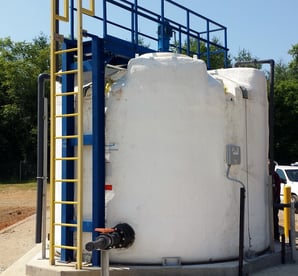
Mechanical mixer systems are among the most widely used agitation solutions in industrial chemical storage. A motor-driven agitator shaft and impeller mount above the tank and extend into the liquid, creating the circulation needed to keep chemicals in suspension or solution. Imagine an outboard motor on a fishing boat.
Several mounting configurations are available to match different tank sizes and mixer weights — from compact freestanding supports for small open-top tanks to heavy-duty mixer bridges for large vertical tanks. Proper mounting is essential: an improperly supported mixer can introduce mechanical stress into the tank structure, cause vibration-related fatigue at fitting connection points, and compromise both mixer and tank integrity. Mixer shaft penetrations can be factory-drilled with complete dimensional specifications provided in advance.
The primary trade-off with mechanical systems is chemical compatibility. Mixer shafts and impellers are almost always fabricated from metal, and metal components can be attacked by oxidizing chemicals such as sodium hypochlorite, sulfuric acid, and hydrogen peroxide. For applications where metal compatibility is a concern — or where minimizing footprint and maintenance is a priority — large bubble mixing offers a compelling alternative.
Do You Need to Use Baffles for Tank Mixing Applications?
Large Bubble Mixing
Large bubble mixing achieves thorough, uniform agitation without any moving parts inside the tank. A compressed-air or inert-gas supply delivers precisely timed pulses through accumulator plates secured to the tank floor. When a pulse is released, it travels laterally beneath the plate, accumulates into a large rising bubble, and creates a localized vacuum that draws liquid upward from the tank bottom. As the bubble rises, it pushes liquid outward toward the tank perimeter, producing a circulation pattern that folds bottom fluid into the upper volume and distributes chemicals uniformly throughout.
The result is comprehensive mixing that addresses stratification, prevents sediment accumulation, and maintains chemical homogeneity — all without a motor, shaft, bearing, or any wetted metal component inside the tank. For facilities that manage oxidizing chemicals or other substances incompatible with metal mixer components, this is a significant structural advantage.
From an operational standpoint, large-bubble mixing delivers a reduced maintenance burden, lower life-cycle costs, and fewer unplanned downtime events. There are no impeller bearings to replace, no shaft seals to maintain, and no motor windings to fail. This makes it particularly well suited for remote installations, unstaffed pump stations, and facilities where operations teams cannot absorb frequent maintenance demands.

Pump Mixing with In-Tank Eductors
A third approach leverages the existing pump infrastructure to achieve agitation without a separate mechanical drive or compressed gas supply. Pump mixing routes the fluid from the tank through an external pump and returns it through a specially designed in-tank eductor nozzle, typically mounted on the tank dome. This is similar to a fish tank or swimming pool circulation system.
The eductor accelerates the returning fluid stream into a high-velocity jet that entrains surrounding fluid, creating a directed, high-energy flow pattern throughout the tank volume. The nozzle angle and pump discharge rate are calibrated to the specific chemical application and tank geometry to ensure effective mixing coverage.
In some configurations, adequate mixing can be achieved using a pump discharge fitting alone, without a dedicated eductor — although consulting a pump sizing expert is always recommended to confirm whether this simplified approach is appropriate.
Because pump mixing relies on the same infrastructure used for chemical transfer and dosing, it can be cost-effective for facilities with existing pump systems. The trade-off is that effectiveness depends heavily on eductor placement, pump sizing, and flow geometry — all of which must be carefully engineered for the specific tank configuration.

Chemical Compatibility Is the Foundation
Regardless of which mixing approach fits your operational requirements, chemical compatibility must be the starting point for every component decision. A mixing system that isn’t fully compatible with the stored chemical will degrade, contaminate the product, and ultimately fail.
The tank, fittings, IMFO® system (if applicable), mixer mount, agitator components, and pump and eductor materials must all be evaluated together against the specific chemical being stored. A single incompatible component in an otherwise well-designed system is enough to compromise the entire installation.

For oxidizing chemicals — sodium hypochlorite, sulfuric acid, hydrogen peroxide, and similar substances — Poly Processing's OR-1000™ system provides an additional layer of protection through an engineered oxidation-resistant inner surface applied to the HDXLPE tank wall. When a mixing system is introduced into a tank storing oxidizing chemicals, confirming OR-1000 compatibility and ensuring all wetted mixer components are appropriately rated is essential.

Get the Design Right from the Start
Make sure you design your chemical storage tank with your mixing needs in mind. Mixing system designs are very difficult to effectively retrofit after the fact. Mixer shaft penetration locations, accumulator plate placement, eductor nozzle position, and pump connection fittings all need to be integrated into the tank design before fabrication begins. Modifying a tank after delivery introduces structural risk, compromises the seamless one-piece construction that makes HDXLPE tanks so durable, and may void manufacturer warranties.
Poly Processing's chemical storage experts and trusted mixer manufacturer partners can work with customers during the design phase to select the right mixing system, confirm compatibility across all components, and ensure factory-drilled penetrations are accurately located and properly sealed. Whether your application involves water treatment chemicals, industrial process fluids, or specialty substances in pharmaceutical or food and beverage production, getting the mixing system right before the tank ships is always the most effective and cost-efficient path.
If you’re designing a new chemical storage system that requires agitation, or evaluating an existing mixing configuration, contact a Poly Processing chemical storage expert to discuss your application.

Posts By Topic

Tech Talk Podcast Episodes
Subscribe By Email
Recent Posts
- Sodium Hypochlorite Tank Containment for Spill Control
- Why One Big Tank Is Your Biggest Risk: The Case for Manifolded Storage
- Why Hydrofluoric Acid Requires Specialized Storage Design
- Causes and Prevention of Stress Cracking in Polyethylene Tanks
- Storing Sodium Chlorite Solution Safely in Industrial Applications
Tank Configurator
Find the recommended tank and system components for your chemical storage challenge.
Configure a Tank Package