

Poly Processing Chemical Storage Tank Designs and Drawings
One of the most critical aspects of choosing and building a chemical storage tank system is tank design. Poly Processing makes this process as simple as possible for you by providing easy access to resources and several types of tank drawings.
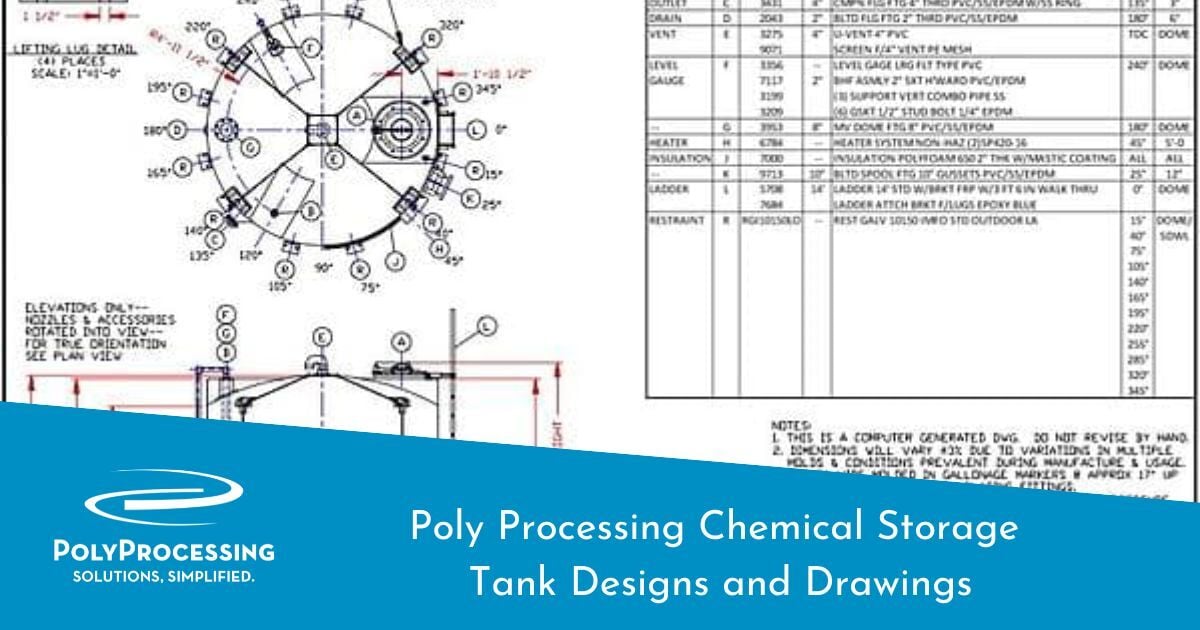
Poly Processing offers several drawing formats, ensuring you order and receive the polyethylene chemical storage tank system you need.
When specifying a chemical storage tank system, the drawings you receive are more than reference documents. They are the engineering foundation for safe installation, regulatory compliance, and long-term operational success. Understanding what each drawing type contains and how to use it is one of the most practical steps a plant engineer or procurement team can take before a tank ever arrives on site.

If you don’t consider the right factors up front, it could be very costly in the long run. You need to know several considerations of your tank’s design, including:
- Chemical being stored
- Tank dimensions
- Tank placement
- Coordinating fittings
- Manways
- Ladder placement
- Seismic Systems
You can view several types of stock product drawings on our website, or work with us to develop a custom design for your specific storage needs. This helps ensure you’ll get the following benefits:
- Easier tank design, fitting placement, and overall project development
- Increased productivity for engineers, contractors, and customers
- Greater design accuracy to eliminate errors during the project design and development phase
What Types of Drawings Does Poly Processing Provide?
Poly Processing provides multiple drawing formats to support every stage of the tank lifecycle, from initial specification and procurement through installation, inspection, and maintenance. Each format serves a distinct purpose and audience.
Poly Processing offers the following drawing types:
- Dimensional Drawings: Show the physical dimensions of the tank, including height, diameter, wall thickness, and the location of all fittings and accessories. These are the most commonly requested drawings for site planning and installation.
- Engineering Drawings: Provide detailed technical specifications, including fitting locations, accessories to be included, etc.
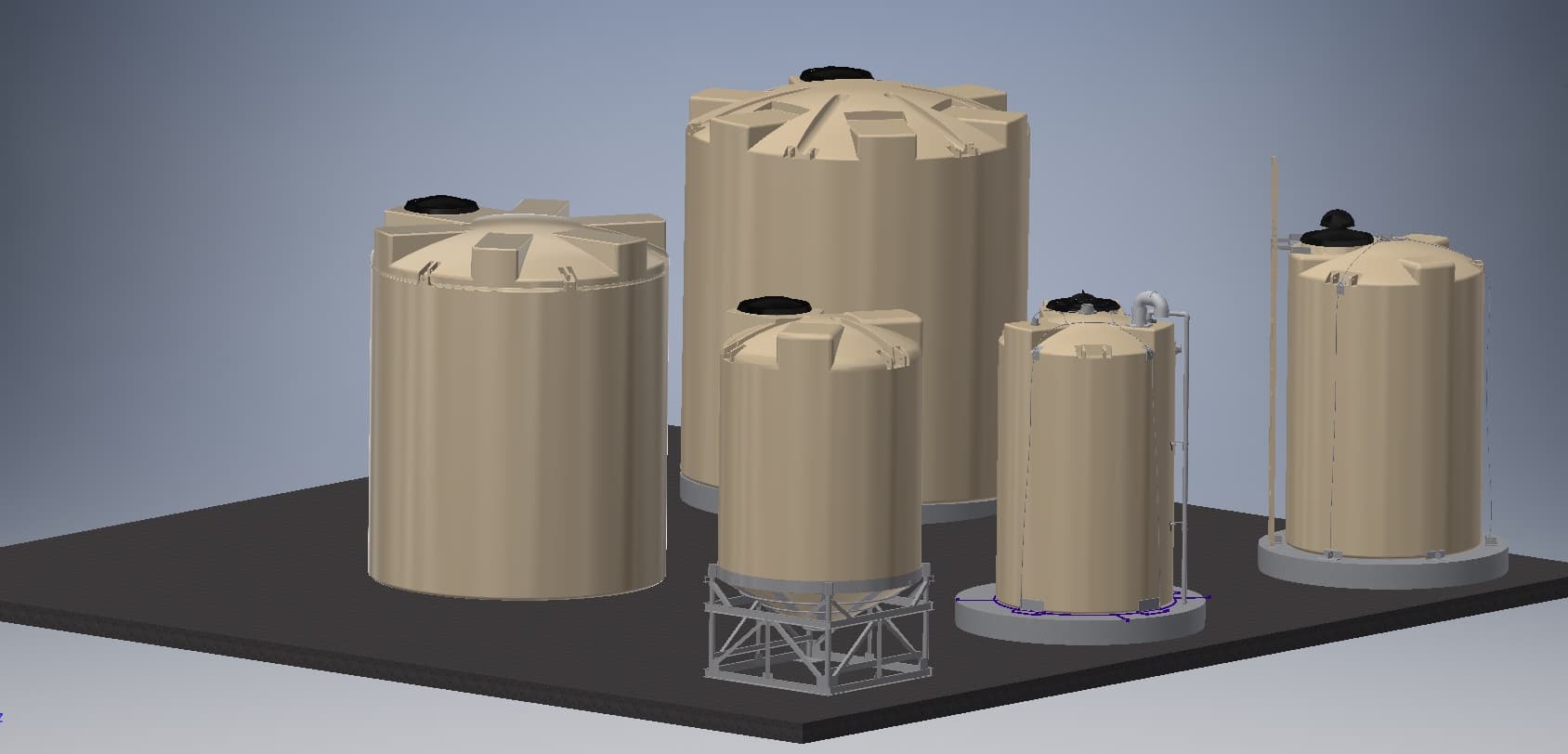
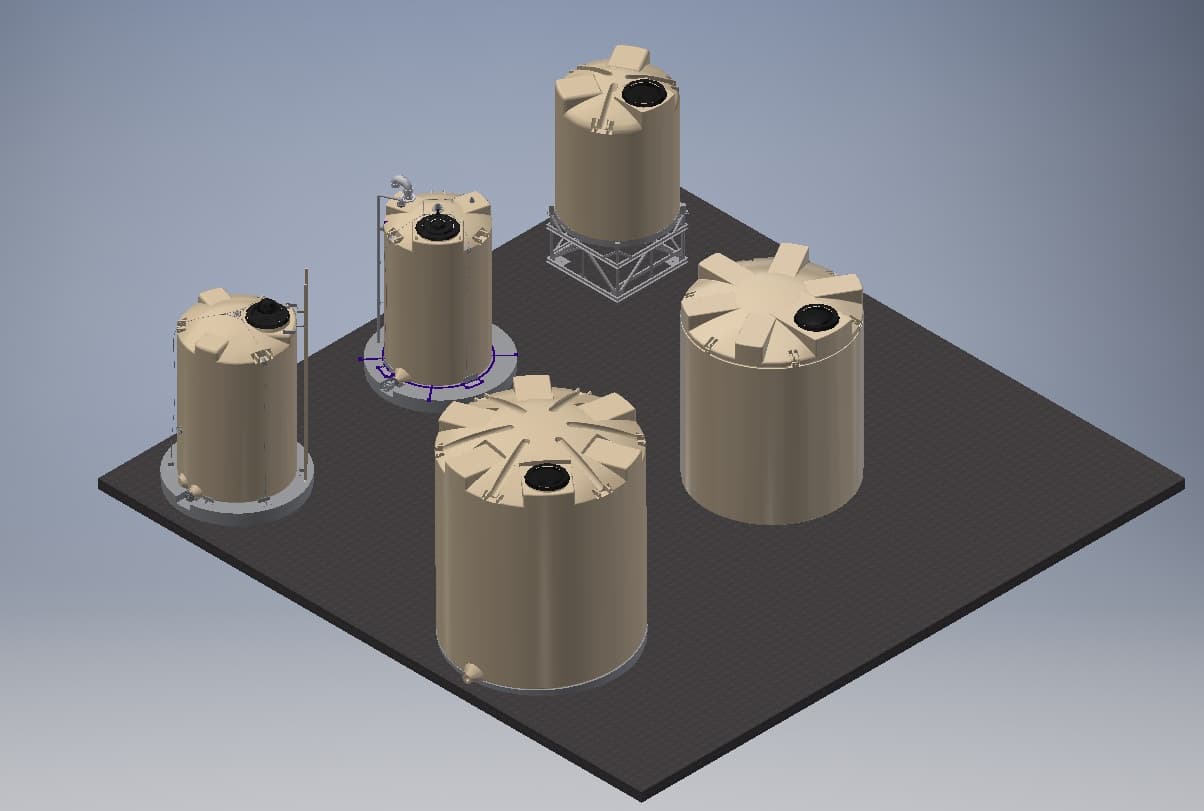
- CAD Drawings: Available in standard formats for integration into plant layout software. CAD files allow engineering teams to incorporate the tank into broader facility designs, piping layouts, and secondary containment plans. If you don’t have a CAD program on your computer, you can use Autodesk Viewer to view the 3D file.
- System Drawings: For complex tank systems such as the SAFE-Tank® double-wall system or tanks equipped with the IMFO® (Integrally Molded Flanged Outlet), system drawings show how all components interact as a complete assembly.
Poly Processing has 3D Step (.stp) drawings/files for our verticals, IMFO® Tanks, and SAFE-Tanks®. Step is a standardized graphic exchange file format that can be used to exchange data between CAD and other drawing systems. This 3D tank drawing/file format is nearly universal and can be used by many different programs.
How Do I Read a Poly Processing Tank Drawing?
A Poly Processing tank drawing contains several key data fields that, once understood, allow engineers and plant managers to quickly verify that a specified tank matches the requirements of their application. Knowing where to look and what each field means prevents costly specification errors before an order is placed.
Here is a step-by-step guide to reading a standard Poly Processing dimensional or engineering drawing:
- Locate the Title Block. The title block, typically found in the lower right corner, contains the tank model number, revision date, drawing number, and tank size. Always confirm you are working from the most current revision.
- Review the Tank Dimensions. Check the overall height, outside diameter, and sidewall thickness. Cross-reference these against your site's available footprint, secondary containment dimensions, and any overhead clearance restrictions.
- Identify Fitting Locations. All fittings, including inlet, outlet, vent, and manway locations, are called out with a letter or number designation and referenced in a fitting schedule table. Confirm that fitting sizes, types (threaded vs. flanged), and positions match your piping design.
- Note Any Special System Features. If the drawing references the SAFE-Tank® system, confirm that both the inner and outer tank dimensions are shown, along with the interstitial space specifications. For IMFO® tanks, verify the flanged outlet location and confirm it aligns with your discharge and piping plan.

Why Do Accurate Drawings Matter for Safety and Regulatory Compliance?
Accurate, up-to-date tank drawings are not just a convenience. They are a regulatory and safety requirement in many jurisdictions. Facilities storing hazardous chemicals are often required to maintain current engineering drawings as part of their Process Hazard Analysis (PHA), PSM (Process Safety Management) documentation, and EPA Risk Management Plans (RMPs).
Submitting outdated or incorrect drawings during a regulatory inspection can result in citations, fines, or mandatory shutdowns. More critically, installing a tank based on an incorrect drawing, particularly one with wrong fitting locations or an understated specific gravity rating, can lead to catastrophic chemical releases.
Key compliance considerations tied to tank drawings include:
- PSM and RMP Documentation: Facilities covered under OSHA's PSM standard (29 CFR 1910.119) or the EPA's RMP rule must maintain accurate P&IDs and equipment specifications, including tank drawings, as part of their process safety documentation.
- Building and Installation Permits: Many municipalities and state agencies require stamped engineering drawings before issuing permits for chemical storage installations.
- Secondary Containment Design: Accurate dimensional drawings are required to properly size secondary containment structures to meet EPA Spill Prevention, Control, and Countermeasure (SPCC) regulations.
- Insurance and Liability: Insurance carriers increasingly require current engineering documentation for chemical storage assets. An accurate drawing package supports your facility's risk management posture.
Poly Processing recommends that facilities maintain a complete drawing package for every tank in service, including the original dimensional drawing, any revision history, and the system drawing for tanks with integrated components such as the IMFO® or SAFE-Tank® system.

How Do Drawings Connect to the Tank Ordering and Customization Process?
Almost every Poly Processing tank order begins with a drawing. The drawing is the primary communication tool between your team and Poly Processing's tank specialists, ensuring the manufactured tank matches your exact chemical storage requirements.
The process works as follows:
- Initial Specification: Your team provides the chemical to be stored, the required capacity, the specific gravity, the operating temperature range, and a marked-up drawing for us to work with. Poly Processing uses this information to select the correct tank model, wall thickness, and system configuration.
- Preliminary Drawing Review: Poly Processing issues a preliminary drawing for your team to review and approve. This is the critical checkpoint where fitting locations, sizes, and system features are confirmed before manufacturing begins.
- Revision and Approval: If changes are needed, revised drawings are issued. Most standard tank configurations require only one revision cycle, but complex systems with multiple fittings, custom covers, or integrated secondary containment may require two or three review cycles. Building this time into your project schedule prevents delays.
- Manufacturing Release: Once the drawing is approved and signed off, it is released to manufacturing. The approved drawing becomes the production specification and the permanent record for that tank.
- As-Built Drawing: After manufacturing, Poly Processing can provide an as-built drawing that reflects the actual tank as produced. This as-built drawing is the document your facility should retain for compliance, maintenance, and future reference.
To request drawings for a specific tank configuration or to speak with an application engineer about your chemical storage requirements, contact Poly Processing's team of experts.

What Drawing Formats Are Available and How Do I Request Them?
Poly Processing provides drawings in multiple formats to accommodate different engineering workflows and software platforms. Standard formats include PDF for review and approval, as well as DWG and STEP file formats for integration into plant design software.
To request drawings:
- For existing tanks: Contact your Poly Processing sales representative with the tank model number and serial number. Most drawings, if available, are typically fulfilled within one to two business days.
- For new specifications: Work with a Poly Processing application specialist to develop the specification. Preliminary drawings are typically issued within three to five business days of receiving a completed purchase order with marked-up drawings.
Download Poly Processing's tank specification guide to prepare the information your application specialist will need to generate an accurate drawing for your application.
Frequently Asked Questions About Poly Processing Drawings
Q: Can I request a drawing before placing an order?
A: Yes. Poly Processing encourages engineering teams to review and approve a preliminary drawing before finalizing an order. This ensures the tank configuration is correct before manufacturing begins and prevents costly change orders or returns. There can be a cost associated with drawings if a purchase order is not entered at the time of the request.
Q: How do I know if my drawing is current?
A: Always reference the revision date and revision number in the title block of the drawing. If you are unsure whether you have the most current version, contact Poly Processing with the drawing number and we will confirm the current revision status.
Ready to Get Started on Your Tank Design?
Contact a chemical storage tank expert today to see how we can help you design the right drawings for your specific storage needs.

Posts By Topic

Tech Talk Podcast Episodes
Subscribe By Email
Recent Posts
Tank Configurator
Find the recommended tank and system components for your chemical storage challenge.
Configure a Tank Package