
Chemical Storage Requirements for Pharmaceutical Manufacturing
Pharmaceutical manufacturing is one of the most tightly controlled industries in the world, and for good reason. Every tablet, vial, and syringe that reaches a patient depends on a long chain of precise chemical processes, and those processes depend on chemicals being stored safely, cleanly, and reliably.
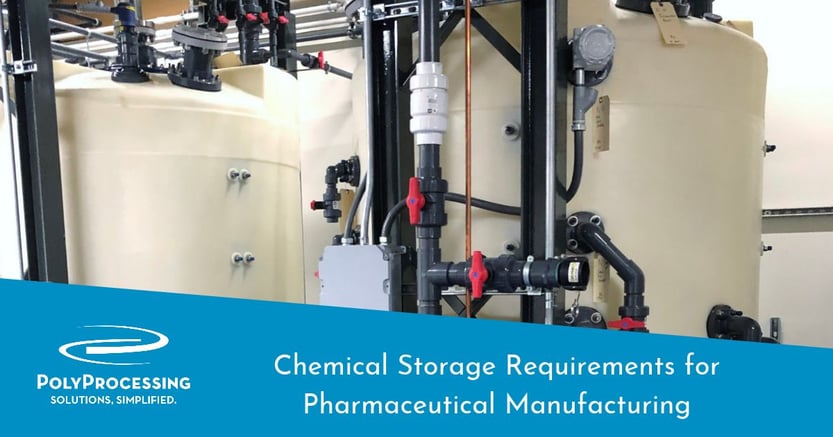
When people picture pharmaceutical production, they usually imagine sterile clean rooms, white-coated scientists, and gleaming stainless-steel equipment. What they rarely picture is the storage tank sitting quietly outside the plant, holding the acids, caustics, and disinfectants that make the whole operation possible. Yet those tanks are just as important as anything inside the building. A storage failure can contaminate a product batch, endanger workers, or shut down a production line for weeks.
This article explores the chemical storage requirements that govern pharmaceutical manufacturing and explains why high-density crosslinked polyethylene (HDXLPE) tanks, such as those engineered by Poly Processing, have become a trusted solution for storing the chemicals that pharmaceutical plants rely on every day.

Why Chemical Storage Is a Safety and Compliance Issue
Pharmaceutical manufacturers must meet a demanding set of regulators, including the U.S. Food and Drug Administration (FDA), and strict standards for product purity and worker safety. Production chemicals are often corrosive, oxidizing, or hazardous, and they must be stored in containers that will not react with them, leak, or introduce contamination. The storage tank itself becomes part of the quality system.
For years, stainless steel was the default choice for pharmaceutical storage. It is strong and familiar, but it has real drawbacks. Stainless steel can develop chemical attack points, and its seams and welds are especially vulnerable to corrosion and compromise. As a result, stainless tanks often require expensive coatings and ongoing maintenance and inspection. Those costs add up, and every weld can be a point of failure. Modern resin technology has changed the equation. HDXLPE tanks now meet many regulatory requirements and offer a cost-saving alternative to stainless steel without sacrificing safety or cleanliness.

The Case for HDXLPE Tanks
Not all polyethylene is created equal. Linear polyethylene and crosslinked polyethylene (XLPE) are both made from heated resins, but the manufacturing process produces very different materials. Crosslinking forms bonds between polymer chains, tying them together and dramatically increasing molecular weight. The result is a plastic with impact resistance, tensile strength, and resistance to fracture that linear polyethylene simply cannot match.
The numbers are striking. Compared with standard high-density polyethylene, XLPE offers ten to twenty times the environmental stress crack resistance, ten times the molecular weight, and three to five times the impact and tensile strength. Compared with fiberglass-reinforced plastic, XLPE's seamless construction eliminates the seams where chemicals can wick into the fiber and compromise tank life. Compared with carbon and stainless steel, XLPE offers broad chemical resistance without high-cost coatings and avoids welds and seams that create chemical attack points.

For pharmaceutical storage, the most important priority is keeping stored chemicals clean and debris-free while preventing absorption into the tank wall. HDXLPE's seamless, one-piece construction helps because it has no small crevices where bacteria could grow. During manufacturing, the crosslinking process essentially turns the tank into one giant molecule, with no seams or weak spots. Poly Processing's exclusive OR-1000 system takes this further by adding a protective barrier on the inner surface that is molecularly bound to the polyethylene, helping prevent bacterial growth and extending tank life in aggressive environments.

What Chemicals Are Stored in HDXLPE Tanks in Pharmaceutical Manufacturing
Pharmaceutical plants store a wide range of chemicals, and HDXLPE tanks are used across many of them. The chemicals generally fall into a few practical categories.
The first is clean-in-place, or CIP, chemicals. Pharmaceutical equipment must be cleaned and sanitized between production runs, and that cleaning relies on strong chemicals. Sodium hydroxide, also known as caustic soda or liquid lye, is one of the most common. It is used to break down residues and adjust pH, and it is notoriously difficult to store because it is “slippery” and tends to find leak paths. It is also extremely corrosive to tissue and can crystallize if not kept at the right temperature. Acids such as phosphoric, nitric, and sulfuric acid are used alongside caustics to remove mineral deposits and neutralize surfaces. Because these chemicals are so aggressive, they demand tanks with strong, safe containment.

The second category is disinfectants and sanitizers. Peracetic acid, or PAA, is a highly effective antimicrobial agent formed by blending hydrogen peroxide and acetic acid. It breaks down into acetic acid, oxygen, and water, leaving no harmful residue, which makes it popular in aseptic packaging, filling, and water treatment. It is also one of the strongest oxidizing chemicals used in industry, so it requires careful storage, containment, ventilation, and process controls. Sodium hypochlorite, the active ingredient in bleach, is another common sanitizer, as is hydrogen peroxide. These oxidizing chemicals can degrade standard storage materials over time, which is exactly the problem the OR-1000 resin system was designed to address. By adding an engineered antioxidant system between the chemical and the XLPE, OR-1000 can reduce oxidation rates by up to 75 percent and deliver four times the antioxidant strength of ordinary polyethylene.

The third category is water-treatment and pH-adjustment chemicals. Pharmaceutical manufacturing uses large quantities of purified water, and the systems that produce it depend on ion exchange resins that must be regenerated periodically with acids and caustics. Sodium hydroxide, hydrochloric acid, and sulfuric acid all serve this role. The same chemicals also adjust pH throughout production and are stored in HDXLPE tanks built to handle their corrosive nature.
The fourth category is wastewater treatment chemicals. Every large pharmaceutical manufacturer operates a wastewater treatment plant before releasing water into the sewer system, because production generates waste streams that must be neutralized and cleaned. Ferric chloride, alum, and various polymers remove solids and clarify water, while sodium hypochlorite disinfects it. Many of these chemicals generate sludge that must be fully discharged, which makes tank design a critical consideration.

Beyond these categories, pharmaceutical plants store other aqueous chemicals, including liquid ammonium sulfate and buffer solutions. The common thread is that these are water-based, corrosive, or oxidizing chemicals that HDXLPE handles well, while solvents and other aggressive organics typically require different materials.
Tank Design Features That Matter
Storing the right chemical is only half the battle. The tank's design determines how safely and efficiently it performs over its service life, and pharmaceutical manufacturers should pay attention to a few key features.
Complete drainage is essential. Chemicals that generate sludge or produce hazardous fumes need tanks that empty completely so residue doesn't accumulate. Poly Processing's Integrally Molded Flanged Outlet, or IMFO, system solves this by molding the flange into the tank at its lowest point, below the knuckle radius. Because the flange is molded from the same material as the tank, it is a stress-free part of the structure, and it eliminates the leak paths that come with drilled holes and bolted fittings. IMFO tanks can be cleaned from the top with a high-pressure sprayer or spray nozzle, so personnel never have to enter the tank. Poly Processing recommends annual cleaning for normal usage, with more frequent cleaning as needed.

Secondary containment is equally important. Because many pharmaceutical chemicals are corrosive and hazardous, regulators and safety managers often require a backup in case the primary tank fails. When floor space is limited, a double-wall system like the SAFE-Tank provides a “tank within a tank” that delivers 110 percent containment capacity without the need for a large, high-maintenance concrete containment area. The all-in-one design isolates the stored chemical from contamination, protects employees, and reduces environmental remediation risk, all within the footprint of a standard vertical tank. When secondary containment is already available, a single-wall vertical tank with IMFO is often the ideal choice.

Material quality and certification round out the picture. HDXLPE tanks carry FDA-compliant construction and NSF-61 certification for dozens of chemicals, and Poly Processing manufactures them at facilities in Louisiana, California, and Virginia. That combination of compliance, availability, and proven performance is why pharmaceutical companies nationwide use these tanks for pre-production storage, post-production storage, product mixing, and wastewater treatment.
Choosing the Right Tank
Selecting a storage tank is not a casual decision. The chemical's properties should drive every choice, and a common and dangerous misconception is that any tank suitable for water will work for chemicals. That assumption can lead to degradation, leaks, or dangerous reactions. The right approach is to match the chemical's compatibility, temperature, and handling requirements with a tank and fitting system engineered for the job.

Conclusion
Chemical storage may not be the most visible part of pharmaceutical manufacturing, but it is one of the most important. The acids, caustics, disinfectants, and treatment chemicals that make production possible must be stored in tanks that protect product purity, worker safety, and the environment. HDXLPE tanks, with their seamless construction, exceptional strength, and specialized features like OR-1000, IMFO, and the SAFE-Tank, have earned their place in the pharmaceutical industry by meeting those requirements while controlling long-term costs. For manufacturers weighing their options, the message is clear: the storage tank is not a commodity; it is a critical piece of the quality and safety system, and it deserves to be chosen with the same care as any other part of the process.

Posts By Topic

Tech Talk Podcast Episodes
Subscribe By Email
Recent Posts
- Chemical Storage Requirements for Pharmaceutical Manufacturing
- Storing Liquid Chlorine and Sodium Hypochlorite Safely: Design Lessons from Poly Processing
- What Causes Chemical Tank Failure in Oxidizing Applications?
- Understanding the Specific Gravity of Crosslinked Polyethylene Tanks
- Safe Storage Solutions for Liquid Fertilizers: Why Crosslinked Polyethylene Sets the Standard for Safety and Longevity
Tank Configurator
Find the recommended tank and system components for your chemical storage challenge.
Configure a Tank Package