

What Causes Chemical Tank Failure in Oxidizing Applications?
Oxidizing chemicals are among the most demanding substances a storage tank will ever hold. Sodium hypochlorite, sulfuric acid, hydrochloric acid, peracetic acid, and hydrogen peroxide are aggressive by design — their entire purpose is to react with and break down other materials. When that reactivity is aimed, however unintentionally, at the tank wall itself, it can cause a slow-motion failure that begins long before anyone notices a leak.
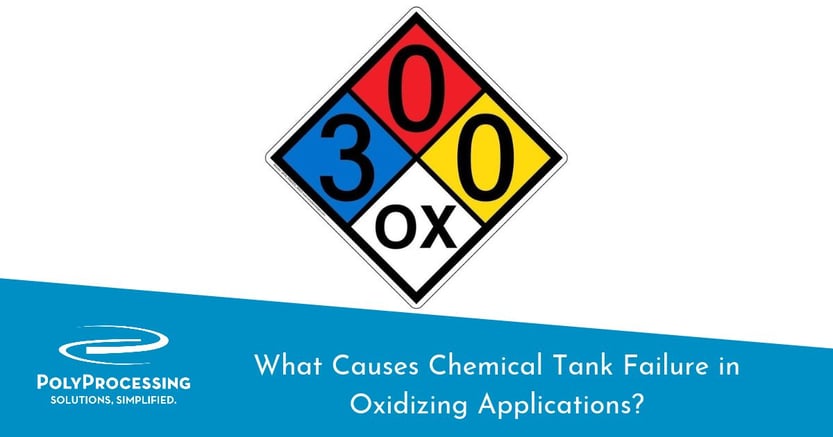
Understanding why tanks fail in oxidizing service is the first step toward preventing it. Drawing on decades of field data and polymer engineering from Poly Processing, the leading manufacturer of rotationally molded crosslinked polyethylene (XLPE) storage tanks, this article examines the root causes of tank failure in oxidizing environments — and the design decisions that keep tanks in service far longer.

Oxidative Degradation: The Core Failure Mechanism
At the heart of most oxidizing-application failures is oxidative degradation of the polyethylene itself. Most polyethylene resin already contains antioxidants, but those antioxidants in many cases are largely consumed during the manufacturing process. As the tank is cured and molded, the resin is exposed to heat and oxygen, and the antioxidants are spent before the tank ever goes into service. By the time the tank is storing chemical, much of its built-in protection is gone.
Once in service, a strong oxidizer attacks what remains. Over time, the polymer chains lose their ability to stretch and flex. The technical measure of this is tensile elongation to break — and when it drops, the tank wall becomes increasingly brittle and far more susceptible to cracking and leaking.
This is not a theoretical concern. In laboratory testing that exposed tank materials to 12.5% sodium hypochlorite (industrial-strength bleach) at 40°C, conventional polyethylene tanks lost an average of 30% of their original tensile elongation after just nine months. Poly Processing’s engineered antioxidant systems lost only about 3% over the same period — roughly ten times greater resistance to oxidative degradation. The takeaway is clear: in oxidizing service, the difference between a tank that lasts and one that fails often comes down to how well its material resists oxidation from day one.

Environmental Stress Cracking: Where Oxidation and Stress Collide
Oxidation rarely acts alone. Its most damaging partner is environmental stress cracking (ESC), a polymer failure caused by surface-initiated microcracks that form when physical stress and chemical exposure act together.
A tank under normal mechanical stress may be perfectly fine. A tank exposed to an aggressive chemical may also be fine. But when the two combine, the chemical — particularly a surfactant or aggressive oxidizer — interacts with the polymer surface and accelerates the formation of microscopic voids within the polymer chains. These tiny cracks are often invisible during a routine inspection. With repeated stress and continued chemical exposure, they connect and grow into larger cracks that can propagate through the wall, producing leaks and, in the worst case, sudden tank failure.
Several factors feed this process. Chemical concentration and temperature both matter enormously: a tank that performs well at one concentration may not be appropriate at a higher one or at elevated temperatures. Temperature swings compound the problem. Outdoor tanks endure hot days, cold nights, seasonal shifts, and UV exposure, and heated chemicals add further stress. Polyethylene expands and contracts with temperature, and the question is whether the tank and its connected system are engineered to handle that movement.

Material Choice: Why Linear Polyethylene Fails Catastrophically
The material a tank is made from determines how it behaves once a crack begins — and this is where linear versus crosslinked polyethylene diverge sharply.
High-density linear polyethylene (HDPE) is common and can be practical for water or mild materials. But its polymer chains are linear, so when a crack starts, there is little internal structure to stop it. Under mechanical stress, an HDPE tank can fail catastrophically as the crack "unzips" through the material. Linear polyethylene simply lacks the molecular network that slows crack growth.
High Density Crosslinked Polyethylene (HDXLPE) behaves differently. During crosslinking, bonds form between polymer chains, transforming separate linear chains into a connected network with dramatically higher molecular weight. That network is why HDXLPE delivers ten to twenty times the environmental stress crack resistance of HDPE, ten times the molecular weight, and three to five times the impact and tensile strength. If a crack develops in an HDXLPE tank, the crosslinked chains resist propagation — the material behaves less like a zipper and more like a reinforced net. For demanding oxidizing service, this is a decisive advantage.

Mechanical Stress, Pressure, and Venting
Even the best material can be undermined by how a tank is used and installed. Tanks expand and contract as they are filled and emptied, and the changing weight of liquid alters the load on the wall. Piping that is not independently supported can pull on fittings, while rigid plumbing can transfer vibration and movement directly into the tank. A tank installed on an uneven surface develops localized stress points. Over time, these conditions create the very stress concentrations where cracking begins.
Pressure and vacuum conditions are another frequent culprit. Polyethylene chemical storage tanks are not built to withstand pressure. If a tank is not vented correctly, filling and discharge can create pressure or vacuum the tank was never designed to handle. Venting should be treated as an integral part of the storage system, not an afterthought accessory. During filling, air and vapor must escape; during discharge, air must enter. An undersized or blocked vent turns a routine transfer into a mechanical strain on the tank wall.

Preventing Failure: Design the Tank Around the Chemical
The most reliable way to prevent failure in oxidizing applications is to design the storage system around the chemical and its operating conditions from the beginning. A chemical storage tank should never be treated as a generic container. The right tank depends on the chemical, its concentration, temperature, specific gravity, location, fill and discharge method, venting needs, fittings, accessories, and regulatory requirements.
For oxidizing chemicals specifically, Poly Processing developed the OR-1000™ engineered resin system. Rather than relying on the depleted antioxidants in standard resin, OR-1000 adds a dedicated antioxidant barrier between the oxidizing chemical and the high-density crosslinked polyethylene. During rotational molding, the two surfaces are molecularly bound, creating a seamless bond, and the system provides four times the antioxidant power of a standard tank wall. Because all wetted surfaces are covered, the protection extends throughout the tank, and the system can be applied to most Poly Processing tanks, including SAFE-Tank® double-wall and IMFO® designs. The result is dramatically extended service life in environments where standard polyethylene would degrade.

Material selection is only the starting point. Pairing an oxidation-resistant resin system with a proper chemical-compatibility review, correct installation, adequate venting, supported piping, and regular inspection gives the entire system the best chance at long service life. Routine inspections should look for crazing, cracking, whitening, bulging, leaks, fitting stress, foundation issues, and plumbing loads — the early warning signs that precede a larger failure.
The Bottom Line
Chemical tank failure in oxidizing applications is rarely caused by a single condition. It is the combined effect of oxidation, chemical exposure, mechanical stress, temperature, cycling, installation quality, and time. Linear polyethylene offers limited resistance to crack growth, while crosslinked polyethylene — especially when paired with an engineered antioxidant system like OR-1000 — provides a far stronger foundation for safe, reliable storage.

A chemical storage tank is not the place to cut corners. The cost difference between a basic tank and a properly engineered tank system is small compared with the cost of a failure. When the application involves aggressive oxidizers, elevated temperatures, or a high consequence of failure, designing the tank around the chemical is the surest way to protect people, assets, and uptime.

Posts By Topic

Tech Talk Podcast Episodes
Subscribe By Email
Recent Posts
- What Causes Chemical Tank Failure in Oxidizing Applications?
- Understanding the Specific Gravity of Crosslinked Polyethylene Tanks
- Safe Storage Solutions for Liquid Fertilizers: Why Crosslinked Polyethylene Sets the Standard for Safety and Longevity
- The Unsung Equipment Behind Data Center Uptime: Chemical Storage
- Can Stainless Steel Be Used for Corrosive Chemicals?
Tank Configurator
Find the recommended tank and system components for your chemical storage challenge.
Configure a Tank Package