

Safe Storage Solutions for Liquid Fertilizers: Why Crosslinked Polyethylene Sets the Standard for Safety and Longevity
Liquid fertilizers have become indispensable to modern agriculture, and for good reason. They are easy to meter, blend, and apply, and they give growers precise control over the nutrients delivered to a field. But the same qualities that make liquid fertilizers so effective also make them demanding to store. They are dense, often corrosive, frequently temperature-sensitive, and unforgiving of a tank that fails.
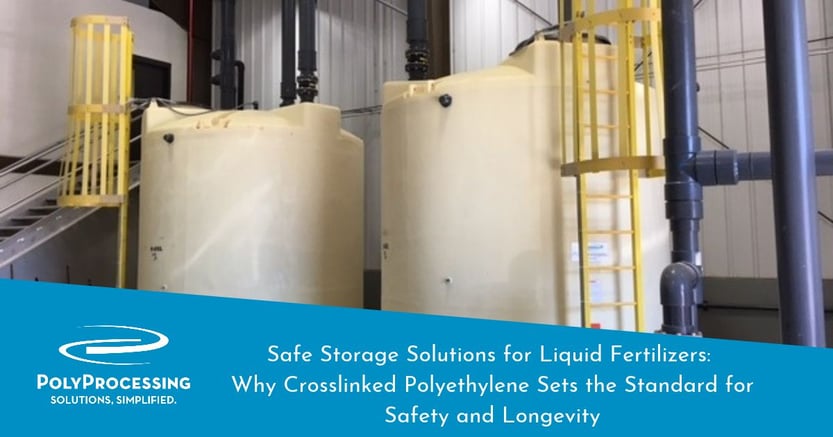
For anyone responsible for storing these products — whether at a farm, a fertilizer retailer, a distribution terminal, or a water treatment facility — the choice of storage tank is not a minor purchasing decision. It is a decision about safety, environmental protection, and the operation's long-term economics.
Poly Processing, a manufacturer of polyethylene chemical storage tanks, has spent decades engineering solutions specifically for these challenges. Its answer to the question of safe liquid fertilizer storage is built on one central material: high-density crosslinked polyethylene, or XLPE. Understanding why XLPE has become the recommended material for liquid fertilizer storage requires looking at how it is made, how it compares with competing materials, and how it performs over the many years a well-designed tank is expected to serve.

The Stakes of Storing Liquid Fertilizer
Liquid fertilizer formulations vary widely. They include products such as liquid ammonium sulfate (LAS), urea ammonium nitrate (UAN), and a range of blended nutrient solutions. LAS, for example, began its life as a liquid fertilizer applied to hard ground before becoming widely accepted as a stable and effective source of ammonia for water treatment. What these products share is a set of storage characteristics that punish inferior tanks. They can be aggressive toward certain materials, they tend to leave sediment behind, and they are often stored outdoors where they are exposed to sunlight and temperature swings.
A tank failure in this setting is not merely an inconvenience. A leak can mean lost product, contaminated soil or groundwater, regulatory exposure, and risk to the people who work around the tank. That is why the industry’s leading manufacturers treat tank integrity as one of the single most important design objectives — and why the material of construction is the first decision to get right.
Why Material Choice Matters
Chemical storage tanks for water treatment, wastewater treatment, and industrial applications are generally available in three main materials: polyethylene, steel, and fiberglass. Each has trade-offs in handling, installation, maintenance, resistance to leakage, and lifetime cost. Steel tanks, for instance, tend to develop pin leaks over time from rust and corrosion, and their welds can create stress points. Fiberglass tanks can vary widely in quality depending on the method and skill of their manufacture, and chemicals can wick into the fiber, compromising the tank from within. These are not abstract concerns; they translate directly into inspection costs, repairs, and shortened service life.

Polyethylene sidesteps many of these problems because it is chemically inert and can be molded into a seamless, one-piece vessel. But “polyethylene” is not a single material. The distinction that matters most — and the one Poly Processing emphasizes repeatedly — is the difference between linear polyethylene (HDPE) and crosslinked polyethylene (XLPE). Although the two sound nearly identical, they behave very differently, and those differences can affect an organization’s bottom line, the safety of its people, and the reliability of its operations.

What Makes Crosslinked Polyethylene Different
Both HDPE and XLPE are made by heating resins to create a cured plastic, but their production methods produce fundamentally different structures. In HDPE, the molecules are connected like a rope — individual threads twisted together but not tied. Crosslinking changes that. Crosslinking is the formation of bonds between the polymer chains, and those bonds are equal in strength and stability to the principal bonds along the polymer backbone. They tie the polymers together and dramatically increase molecular weight. The result is a plastic whose polymer chains — and therefore whose physical properties — are far better than anything that can be achieved without crosslinking.
The practical consequences are significant. Compared with HDPE, XLPE offers roughly ten to twenty times the environmental stress crack resistance, ten times the molecular weight, and three to five times the impact and tensile strength. Those are not marketing figures; they reflect the material’s fundamental structure, and they show up most clearly when a tank is pushed to failure. When HDPE fails, it can fail catastrophically, because its linear polymer chains tend to “unzip.” In some cases the entire tank comes undone, and a small leak becomes a major spill with all stored product lost and cleanup costs that can be considerable. When XLPE develops a small pinhole or tear, by contrast, the chances of a catastrophic failure are extremely low. The operator is unlikely to lose the entire contents, cleanup and replacement are typically far less expensive, and the risk to employees and the environment is dramatically reduced. Poly Processing demonstrates this difference with drop and pressure tests that visually contrast the two resins.

XLPE Versus the Alternatives
The case for XLPE becomes even clearer when it is measured against steel and fiberglass. Against fiberglass-reinforced plastic (FRP), XLPE offers seamless construction for greater strength, whereas chemicals can wick into FRP’s fibers and compromise tank life. XLPE also tends to have a lower cost of ownership because it requires far less maintenance, and FRP often demands special handling to avoid cracking. Against carbon and stainless steel, XLPE’s seamless one-piece construction eliminates the potential for chemical attack points and bad welds, provides very broad chemical resistance without the need for high-cost coatings, requires only limited routine inspection, and delivers a cost-effective alternative to high-priced alloys. Poly Processing holds NSF-61 certification for 38 chemicals on its crosslinked polyethylene tanks, a credential that matters for potable-water-adjacent applications.

Built for the Demands of Liquid Fertilizer
Poly Processing engineers its XLPE systems around the specific requirements of the chemicals being stored, and liquid fertilizers are a clear example. For LAS and similar products, the company’s Integrally Molded Flanged Outlet, or IMFO system, is especially well suited. The IMFO fitting is molded into the tank at the lowest point possible on the sidewall, allowing the tank to discharge through its true bottom sidewall. That design delivers full drainage and makes cleaning easier, while preventing the sediment buildup that shortens tank life. Because the flange is molded into the tank during production rather than attached afterward, its one-piece construction also eliminates leak points that can occur with mechanically attached fittings or molded-in metallic fittings. IMFO tanks are available in both flat-bottom and sloped-bottom configurations, with vertical flat-bottom IMFO tanks available up to 15,500 gallons and sloped-bottom versions up to 15,000 gallons. For LAS storage, Poly Processing recommends components such as PVC fittings, 316 stainless steel bolts, and EPDM gaskets.

Designing for Longevity
Longevity is where the economics of XLPE become compelling. Based on feedback from customers over 50 years, high-density crosslinked polyethylene lasts 40 to 50 percent longer than linear polyethylene — roughly ten additional years of useful service, with 15 to 20 years as the typical useful life of an XLPE tank. HDPE and fiberglass tanks sometimes last only a third as long, particularly when they are not properly maintained. A longer-lasting tank is, quite simply, a less expensive tank.
That said, useful life depends on how the tank is specified, installed, and operated. The chemicals stored, their concentrations, filling frequency, and operating temperature all affect how long a tank lasts. Installation and piping are perhaps the greatest factors: improper installation and “hard” piping are the leading causes of reduced tank life, because polyethylene naturally expands and contracts. Proper flexible connections accommodate that movement and extend the tank’s service life. Venting, though often overlooked, also plays an important role, since polyethylene tanks are rated for atmospheric pressure and require an adequately sized vent to accommodate flow and delivery rates. Continuous cycling, excessive agitation during mixing, and mobile applications also affect longevity. Poly Processing addresses specific challenges with purpose-built innovations, such as the OR-1000 antioxidant system for aggressive chemicals and the IMFO system for full drainage.

Layering in Safety: Secondary Containment
Even the best tank benefits from a second layer of protection, and Poly Processing’s SAFE-Tank double-wall system provides it. Described as a “tank within a tank,” the SAFE-Tank provides at least 110 percent secondary containment, equalizes the liquid, and lets the chemical remain in service until it is convenient to repair the tank. It is ideal for chemicals that can react dangerously, and it eliminates the expense, cost, and maintenance of building large secondary concrete containment areas while minimizing the system’s footprint. Adding a bellows transition fitting maximizes the system’s performance. Facilities that prefer other approaches can also use concrete basins and other double-wall configurations, all of which require regular inspection to remain effective.

The Bottom Line
Safe liquid fertilizer storage comes down to a simple principle: the material of construction determines how safely and how long a tank will perform. Crosslinked polyethylene earns its recommendation because its molecular structure delivers impact resistance, tensile strength, and fracture resistance that linear polyethylene cannot match, and because its seamless, inert construction resists the corrosion and leak points that plague steel and fiberglass. Combined with thoughtful design features like the IMFO system and the SAFE-Tank double-wall containment, XLPE gives fertilizer operations a storage solution built for safety, compliance, and the long haul. For organizations weighing a tank's lifetime cost, that combination of durability and peace of mind is hard to beat.

Posts By Topic

Tech Talk Podcast Episodes
Subscribe By Email
Recent Posts
- Safe Storage Solutions for Liquid Fertilizers: Why Crosslinked Polyethylene Sets the Standard for Safety and Longevity
- The Unsung Equipment Behind Data Center Uptime: Chemical Storage
- Can Stainless Steel Be Used for Corrosive Chemicals?
- Sodium Hypochlorite Tank Containment for Spill Control
- Why One Big Tank Is Your Biggest Risk: The Case for Manifolded Storage
Tank Configurator
Find the recommended tank and system components for your chemical storage challenge.
Configure a Tank Package