

How to Hydro Test Your Poly Processing Tank in the Field
Before you put a Poly Processing chemical storage tank into service, it’s important to conduct a hydro test so that you can commission the tank with confidence. A hydro test verifies the structural integrity of the tank by filling it with water and checking for leaks. The test is one of the most reliable steps to perform before you begin using a Poly Processing polyethylene storage tank.
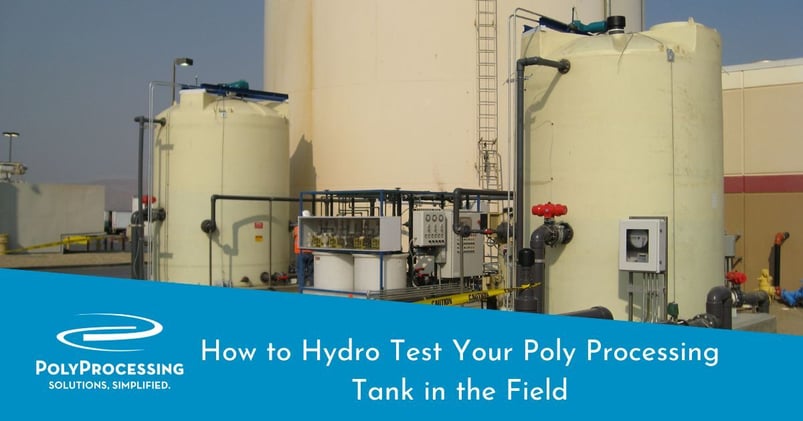
This article provides basic information about when to test, how to do it, which seals to use, and what to watch for while the tank is full.
When Should You Perform a Hydro Test?
Four situations should prompt a hydro test before using your chemical storage tank.
Initial commissioning
When you receive a brand new chemical storage tank from Poly Processing, the hydro test lets you confirm with confidence that every fitting was properly installed and torqued and that no damage occurred during shipping or offloading. Perform the test after the new tank has been set on its pad, and only the tank has been fully plumbed — prior to connecting to downstream piping.
After any fitting replacement or repair
Any time a bulkhead fitting, flange, or valve has been removed and reinstalled, the integrity of that joint must be verified — especially on tanks storing aggressive chemicals such as sodium hypochlorite, sulfuric acid, or hydrochloric acid.

Returning to service after extended idle time
When a tank sits empty for months, gaskets can relax, and bolt torque on flanged connections can shift. A water test catches issues before they lead to chemical spills. If a chemical tank has been empty for an extended period, it may be necessary to replace gaskets.
If a routine inspection raises questions
If your annual visual inspection reveals crazing near a fitting, staining around a connection, or any evidence of past seepage, a hydro test will confirm whether the area is actively leaking and if replacement should be considered. Poly Processing recommends annual visual inspections for all tanks, and a hydro test is a natural complement if any concerns arise.
How to Hydro Test a Poly Processing Tank
Hydro testing is a simple procedure, but it must be performed properly. Follow these steps to ensure your hydro test is performed accurately and safely.
Make sure the tank is empty, clean, and free of chemical residue. Confirm your pad and secondary containment are rated for a full water load.

Step 1: Plug and cap all open fittings
Every outlet, inlet, and unused fitting should be temporarily sealed before filling. See below for details on choosing the right components.
Step 2: Fill slowly with water only
Connect a water supply to the fill line or manway and fill at a controlled rate. Never use pressurized air to test a polyethylene tank. Poly Processing tanks are atmospheric vessels and are not designed to withstand internal pressure.
Step 3: Fill to the rated working capacity
Bring the water level to the normal operating fill level specified for your tank — typically up to approximately 95% of rated volume for most vertical tanks. Always reference your specific tank documentation.
Step 4: Hold and observe
Once full, allow the tank to sit for a minimum of one to two hours and inspect every fitting and connection point. Mark any wet spots for follow-up, then check again at 24 hours for slow seeps.
Step 5: Drain and document
Drain the tank into an appropriate drain or containment area. Photograph and document all findings before returning to service or making repairs.

Plugs and Caps: Choosing the Right Fittings
When sealing the tank for the hydro test, it is critical to use the right temporary closures. The wrong plug material can damage threads or fail under the weight of a full water column.
For threaded fittings (NPTs), use PVC threaded plugs or caps sized to match the thread size. These provide a reliable seal when hand-tightened with PTFE thread seal tape. Avoid metal plugs on polyethylene fittings — differences in thermal expansion and the risk of thread damage make plastic the clear choice.

What to Look for While the Tank Is Full
When inspecting the filled tank, fittings and connections are your primary focus. Look for visible drips, weeping, or moisture at every threaded fitting, flanged outlet, bulkhead, and valve body. Even a slow drip indicates a gasket or torque issue that must be corrected before chemical service.
The tank sidewall and bottom should be dry and uniform. Any wet streaking that originates away from a fitting could indicate a crack or stress fracture. This is rare in new tanks, but it is possible if the tank sustained an impact during delivery.
Transition zones deserve close attention. These are the areas where the sidewall meets the dome and where the sidewall meets the bottom. As Poly Processing's inspection guidelines note, these “corners” are areas where stress can concentrate. Look for bulging, distortion, or moisture that doesn’t trace back to a fitting.
The foundation and pad beneath the tank should also be observed. A new wet spot appearing under the tank that can’t be explained by condensation is a red flag that warrants draining and further inspection.

After the Test
If the hydro test passes with no leaks, drain the tank, remove all temporary plugs and caps, reinstall permanent fittings and valves, and document the successful test with photos and a dated record. The tank is ready for chemical service.
If a leak is found, drain the tank first, identify the root cause (e.g., insufficient gasket compression, cross-threaded fittings, or a damaged fitting body), correct the issue, and retest before proceeding.
For questions about fitting compatibility, inspection procedures, or to schedule a professional field service visit, contact the Poly Processing team or call 866-765-9957.

Posts By Topic

Tech Talk Podcast Episodes
Subscribe By Email
Recent Posts
- Flexible Connectors and Isolation Valves: Why Correct Installation Protects Your Chemical Storage Tank
- Why ASTM D-1998 Still Matters: The Standard That Separates Serious Tank Manufacturers from the Rest
- Brine Storage Tank Solutions: Material and Manufacturing
- Understanding Pressure Limits in Polyethylene Chemical Storage Tanks
- Easy Level Monitoring with the Reverse Float Level Gauge
Tank Configurator
Find the recommended tank and system components for your chemical storage challenge.
Configure a Tank Package