

Why SAFE-Tank® Outperforms Double-Wall Tanks
When it comes to safely storing hazardous chemicals in full compliance with federal environmental regulations, not all double-wall tanks are created equal. Poly Processing’s SAFE-Tank® is the most recognized name in high-density cross-linked polyethylene double-wall chemical storage.
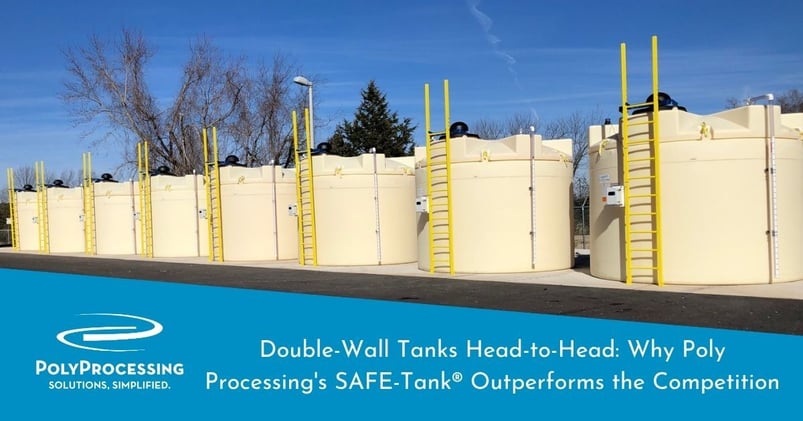
Some competitors offer a tank-within-a-tank design that’s intended to provide secondary containment for bulk liquid chemicals. However, a closer look reveals significant differences in containment, regulatory compliance, piping integration, and long-term operational safety.
If your facility stores corrosive, reactive, or hazardous chemicals and you’re evaluating double-wall tank systems, this comparison will help you understand why the Poly Processing SAFE-Tank is the more complete, more compliant, and more protective solution.

What Is a Double-Wall Tank — and Why Does It Matter?
A double-wall tank, at its most fundamental level, is a tank-within-a-tank. The primary (inner) tank holds the chemical, while the outer tank serves as a secondary containment vessel, designed to capture any leaks or spills from the primary tank before they reach the surrounding environment, threaten personnel, or trigger costly remediation efforts.
Related: The Benefits of Double-Walled Tanks for Hazardous Chemical Storage
 More and more, regulatory agencies (even local agencies) are requiring double wall tanks and double wall piping. The Environmental Protection Agency (EPA) mandates secondary containment for many chemical storage applications. For double-wall tanks specifically, the Code of Federal Regulations — particularly 40 CFR 264.193 — lays out precise requirements that facilities must meet to avoid significant civil penalties.
According to that regulation, a compliant double-wall tank must be designed as an integral structure in which the inner tank is completely enveloped within an outer shell so that any release from the inner tank is contained by the outer shell. It must also be equipped with a built-in, continuous leak detection system capable of detecting a release within 24 hours.
This regulatory framework is the lens through which any serious comparison of double-wall tanks must be conducted. Meeting the letter of 40 CFR 264.193 is the minimum bar — and as we will see, passing that bar requires more than just an outer shell around an inner tank.
The fittings, the piping transitions, and the engineering of every potential leak point matter enormously.

Other Tank Manufacturers Offer Incomplete Systems
The competition manufactures double-wall tanks, and some have copied Poly Processing’s industry-leading tank design. But the sidewall fitting is where the rubber meets the road. The competition manufactures a sidewall fitting solution designed to allow fittings that pass through both walls of the tank. That’s a critical difference, because their designs don’t provide true double-wall piping continuity from the tank to a downstream pump skid or process equipment.
Once the chemical leaves the tank fitting and enters the external piping run, the secondary containment is essentially interrupted — unless additional measures, such as concrete berms or a separate double-walled pipe run, are in place.
This is a critical gap. The piping between a double-wall storage tank and the downstream pump or process equipment is one of the highest-risk sections of the entire chemical handling system. If a leak occurs in that pipe run and it is not contained, the chemical reaches the external environment, defeating the entire purpose of a double-wall tank in the first place.
The Poly Processing SAFE-Tank: Full Containment from Tank to Process
Poly Processing Company developed the SAFE-Tank specifically to address the limitations that exist in conventional double-wall tank designs. Described as a tank within a tank, the SAFE-Tank is manufactured from high-density cross-linked polyethylene (XLPE) and provides a minimum of 110% secondary containment — fully enclosing the primary tank within a protective outer shell.

Available in sizes ranging from 55 gallons up to 10,500 gallons, the SAFE-Tank is designed to eliminate the need for large, expensive, high-maintenance concrete secondary containment systems, fitting the entire containment solution within the footprint of a standard vertical tank.
What truly sets the SAFE-Tank apart is what happens at the fitting and piping transitions. This is where Poly Processing’s engineering investment pays its greatest dividends.

The Bellows Transition Fitting: The Critical Difference
A double-wall tank without double-wall piping is an incomplete solution. The most likely point of failure in any chemical storage system is not the tank wall itself, but the outlet fitting on the lower section of the tank, where the wall must be cut to install plumbing. That cut creates a point of vulnerability that is subject to pressure cycling, thermal expansion and contraction, and vibration — all of which can cause seals to fail over time.
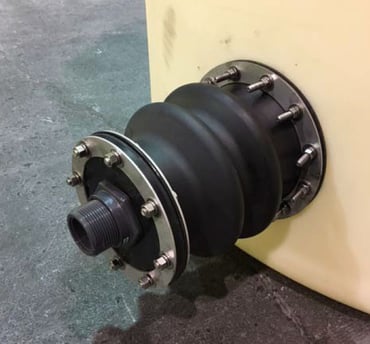
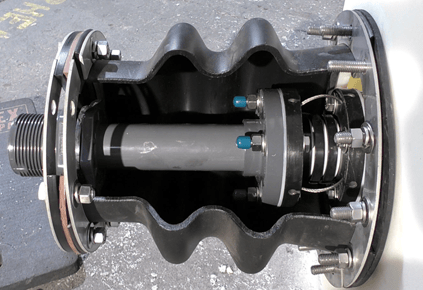
Poly Processing addresses this vulnerability head-on with the Bellows Transition Fitting, a patented innovation no other tank manufacturer offers. The Bellows Transition Fitting features a flexible expansion joint, which is aligned with the outlet pipe and runs through both the inner and outer tank walls.

Surrounding the outlet pipe is a Containment Bellows — essentially a small secondary containment shell around the fitting itself. The Containment Bellows attaches to the outer tank. If the fitting or any of its seals becomes overstressed and fails or leaks, the leaked chemical is captured within the bellows and is directed back into the interstitial containment space, where it triggers the leak-detection sensor.
At no point does the chemical reach the external environment.
This feature sets Poly Processing’s SAFE-Tank apart as the only double-wall tank system that fully meets 40 CFR 264.193. Only the Bellows Transition Fitting ensures that even a fitting failure is contained by the outer shell, thereby satisfying paragraph (i) of that regulation.

True Double-Wall Piping from Tank to Pump
The Bellows Transition Fitting offers what the competition’s double-wall tanks cannot: complete double-wall piping from the tank to the pump skid or pump box. Using the Bellows Transition Fitting on the SAFE-Tank, a six-inch flange can be mounted to the outside of the transition fitting, and a double-wall pipe can be run continuously, keeping everything fully contained throughout the entire fluid path from storage to process.
This is a significant advantage for facilities subject to EPA oversight, particularly wastewater treatment plants, hazardous waste handling sites, semiconductor fabrication facilities, and any operation where chemicals traverse a drinking water catchment area or other environmentally sensitive zone. EPA oversight often requires piping to come out of the bottom of the tank with contained piping to its final destination, such as a pump box.
Poly Processing also manufactures pump skid containment tanks that can be used in conjunction with the SAFE-Tank system to ensure that the pump itself is contained, completing a fully enclosed, end-to-end containment solution.
The EPA Compliance Gap: Where Many Double-Wall Tanks Fall Short
 It is worth dwelling on the regulatory dimension of this comparison, because the stakes are high. Companies that violate 40 CFR regulations can face civil penalties of up to tens of thousands of dollars per day per violation.
Many organizations are unknowingly using double-wall tanks that violate these requirements — not because their tanks are poorly built, but because the fitting and piping transitions were not engineered to contain leaks at the actual points where leaks are most likely to occur.
The specific language of 40 CFR 264.193(c)(1)(i) requires that the tank be designed as an integral structure “so that any release from the inner tank is contained by the outer shell.” The word “any” is doing significant work in that sentence. It does not say “any release from the tank wall,” but any release from the inner tank. That includes releases at fittings, connections, and transition points.
A conventional transition fitting that simply bolts through both tank walls does not guarantee that a failure at the fitting will direct leaked chemical back into the interstitial containment space. The chemical can just as easily travel along the outside of the pipe or fitting to the outer tank, where it spills onto the ground.
The Bellows Transition Fitting physically surrounds the fitting and the outlet pipe with a containment bellows that is sealed to the outer tank. There is nowhere for the leaked chemical to go except back into the containment space between the two tanks, where a leak-detection sensor will detect it. This is genuine compliance with the regulatory intent of 40 CFR 264.193 — not just nominal compliance based on the outer tank's volumetric capacity.
Operational Benefits Beyond Compliance
Beyond regulatory compliance, the SAFE-Tank system offers practical operational advantages that benefit plant operators day-to-day.
If the inner tank of a SAFE-Tank develops a leak, the chemical equalizes between the inner and outer tanks. This means operations can continue — the chemical remains available for use — until it becomes convenient to schedule repairs if necessary. This “graceful degradation” capability minimizes unplanned downtime and avoids the costly scramble of an emergency shutdown.
For hazardous chemicals like sulfuric acid, keeping spilled acid within the containment system and away from water or other incompatible materials is critical. Sulfuric acid reacts violently with water, generating heat and potentially producing dangerous spattering. The SAFE-Tank’s closed interstitial space, combined with the Bellows Transition Fitting’s containment, ensures that the chemical remains isolated from the environment and from water sources at every stage of its containment journey.
The SAFE-Tank also supports heat tracing and insulation for temperature-sensitive chemicals, leak detection sensor options in both polypropylene (PP) and PFA Teflon configurations, and a comprehensive set of engineering drawings in 2D CAD, 2D PDF, and 3D CAD formats to support facility design and permitting.

The SAFE-Tank Is the Complete Secondary Containment Solution
The Poly Processing SAFE-Tank with the Bellows Transition Fitting is in a different class from any other self-containment option. No other chemical storage system meets the full picture of regulatory compliance, fitting-level containment, piping integration, and end-to-end system safety. The SAFE-Tank is the only system that:
- Provides verifiable containment of any release from the inner tank — including releases at fittings and transition points — as required by 40 CFR 264.193(c)(1)(i).
- Enables true double-wall piping from the tank all the way to the pump skid, maintaining secondary containment throughout the entire fluid handling circuit.
- Includes an isolation plate that prevents interstitial leakage from reaching the ground.
- Offers the OR-1000™ oxidation-resistant inner surface for aggressive oxidizing chemicals.
- Provides pump skid containment integration for a complete, end-to-end contained chemical handling system.

For any facility where EPA compliance is non-negotiable, the Poly Processing SAFE-Tank is the clear and compelling choice. To learn more about the SAFE-Tank system and the Bellows Transition Fitting, talk to one of our chemical storage tank experts.

Posts By Topic

Tech Talk Podcast Episodes
Subscribe By Email
Recent Posts
Tank Configurator
Find the recommended tank and system components for your chemical storage challenge.
Configure a Tank Package