

Sodium Hypochlorite Tank Containment for Spill Control
Sodium hypochlorite is one of the most widely used chemicals in municipal and industrial water treatment, and it is also one of the most demanding chemicals to store. Facilities rely on "hypo" to disinfect drinking water and wastewater, to control biological growth in cooling systems, and to sanitize equipment across food and beverage production. It works because it is an aggressive oxidizer — and that same property is what makes it so hard on the tank system holding it.
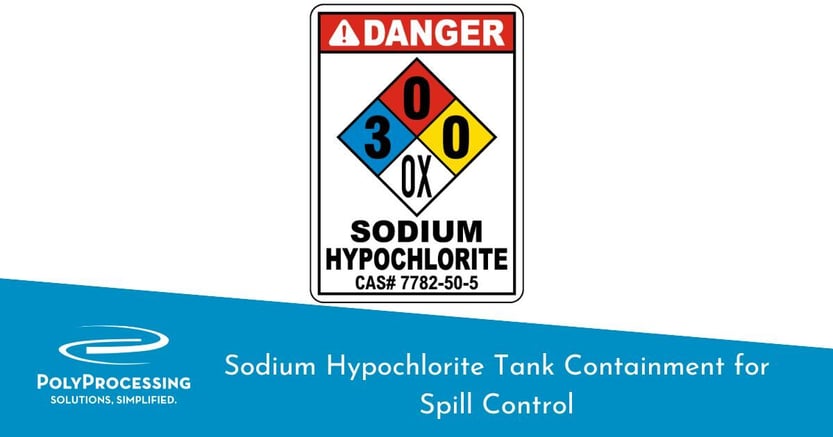
When a chemical storage tank fails, the consequences rarely stop at the tank. A sodium hypochlorite release can damage surrounding equipment and structures, corrode concrete and steel, create hazardous conditions for personnel, contaminate soil and stormwater, and trigger regulatory reporting obligations that follow a facility for years. The chemical itself is lost, the process it feeds goes offline, and the cleanup bill routinely dwarfs the cost of the tank.

This is why containment deserves as much engineering attention as the primary vessel. A well-designed storage system assumes that something, someday, may go wrong — and it is built so that when it does, the consequences are contained, visible, and manageable. Below, we look at why containment matters, what regulations require, how different containment approaches compare, and how Poly Processing's SAFE-Tank® double wall system and OR-1000™ engineered resin system work together to address both halves of the problem.

Why Containment Matters for Sodium Hypochlorite
Containment is often treated as a compliance checkbox. In practice, it is a risk management decision with real financial and operational weight.
Consider what a release actually costs. There is the value of the lost chemical, which for a full bulk tank can be significant on its own. There is emergency response and cleanup, including neutralization, absorbent materials, waste characterization, and disposal of contaminated media as hazardous waste. There is damage to adjacent assets — pumps, piping, electrical conduit, instrumentation, coatings, concrete slabs, and structural steel all suffer when exposed to a strong oxidizer. There is downtime, because a disinfection system that loses its chemical feed cannot simply keep running. And there is the regulatory exposure: reportable releases invite inspections, fines, consent orders, and heightened scrutiny of every other system on site.
Sodium hypochlorite adds its own complications. It is corrosive to skin and eyes and generates chlorine gas when it contacts acids, so a spill that reaches a floor drain shared with an acid feed system creates a serious inhalation hazard. It degrades over time and with exposure to heat and UV light, and its decomposition produces oxygen gas, which means a sealed or improperly vented containment space introduces pressure concerns of its own. It also attacks many of the materials commonly used to build containment structures — untreated concrete in particular is vulnerable to chemical attack that opens cracks and creates pathways to soil and groundwater.
The takeaway is straightforward: containment for hypo has to be chemically compatible, physically reliable, and designed with the specific behavior of the chemical in mind. Generic containment is not enough.
What the Regulations Require
Secondary containment requirements come from several directions, and most facilities are subject to more than one.

The EPA's Spill Prevention, Control, and Countermeasure rule under 40 CFR 112 is the most familiar framework. Its logic — containment sized to hold the largest single container plus freeboard for precipitation — has become the de facto design standard applied far more broadly. For hazardous chemicals, requirements flow through RCRA, the Clean Water Act's stormwater provisions, and state and local codes that frequently go further than federal baselines.
The International Fire Code and Uniform Fire Code address hazardous materials storage directly and generally require secondary containment for corrosive and oxidizing liquids above threshold quantities. Building and plumbing codes weigh in on drainage, separation, and incompatible material segregation. Many states impose additional aboveground storage tank rules, and water utilities often face requirements from state drinking water primacy agencies as well.
Across nearly all of these frameworks, a common design target emerges: containment capacity of at least 110% of the largest tank's volume. The extra 10% accounts for rainfall accumulation in outdoor installations and provides margin for the displacement of any equipment or piping within the containment area. Containment must also be impervious to the stored chemical, and it must be maintained in a condition that keeps it impervious over the life of the installation — which is where many concrete dikes quietly fail.
It is also worth noting that sodium hypochlorite tank systems serving potable water applications need to meet NSF/ANSI/CAN Standard 61 for drinking water system components. Containment decisions should not compromise that certification.

Traditional Containment: Concrete Dikes and Basins
The conventional approach is a concrete dike or berm surrounding the tank, sized to the 110% rule. It is familiar to engineers and contractors, and for some installations it remains appropriate. But it carries real drawbacks that facilities often discover only after years of service.
Concrete is porous. Sodium hypochlorite attacks the cement matrix, and freeze-thaw cycling, thermal movement, and settling all produce cracks. Once cracked, a dike is no longer a containment system — it is a collection basin with a leak. Maintaining imperviousness requires chemically resistant coatings or liners, and those coatings require periodic inspection, repair, and recoating. That is an ongoing maintenance obligation and an ongoing budget line.
Concrete containment also consumes a large footprint. The dike must surround the tank with enough area and wall height to hold 110% of the volume, which can mean a substantial portion of a plant yard dedicated to empty space. On sites where real estate is tight — and most are — that is a meaningful cost.
Then there is rainwater. An open outdoor dike collects precipitation, and that water has to be tested and managed. If it is clean, it can be discharged; if it has contacted chemical residue, it becomes a waste stream requiring characterization and disposal. Over a year, that adds up to a recurring administrative and disposal burden.
Finally, and most importantly, a dike does nothing to keep a facility running. If the primary tank fails, the chemical ends up on the ground inside a basin. The tank is out of service, the chemical is compromised, and the operation stops until a replacement is procured and installed.

The SAFE-Tank® Double Wall System
Poly Processing's SAFE-Tank® takes a fundamentally different approach: a tank within a tank. The primary tank sits inside a second, fully molded high-density crosslinked polyethylene containment vessel, with an interstitial space between them. Both vessels are made from the same chemically resistant material, so the containment layer is every bit as compatible with sodium hypochlorite as the tank holding it.

The system provides at least 110% secondary containment by design, satisfying the standard regulatory target without a separate civil structure. Because the containment is integral to the tank, the footprint shrinks dramatically — there is no dike wall to build, no basin area to give up, and no coating program to maintain. Facilities eliminate the capital cost of concrete containment along with its lifetime maintenance and inspection expense.
The interstitial space is designed to keep contaminants out, which means rainwater does not accumulate in the containment area the way it does in an open dike. That removes the recurring cycle of sampling, testing, and disposing of collected stormwater.
The most operationally valuable feature, though, is what happens during an actual failure. If the primary tank develops a leak, the chemical flows into the interstitial space and the liquid level equalizes between the two vessels. The chemical is fully contained, and it remains usable. Operators can continue drawing from the system and keep the process running until it is convenient to schedule a repair or replacement. Instead of an emergency shutdown, a tank failure becomes a planned maintenance event. For a water treatment plant that cannot simply stop disinfecting, that difference is enormous.
This design is particularly valuable for chemicals where contact between the stored product and water creates hazards. Sulfuric acid, for example, reacts exothermically with water, so an open dike that has collected rainfall is a dangerous place for an acid spill to land. The sealed interstitial space avoids that scenario entirely.

SAFE-Tank systems are available from 55 to 10,500 gallons, covering everything from small day tanks to bulk storage. Adding a bellows transition fitting maximizes system performance by accommodating the movement between the inner and outer tanks as the primary vessel expands and contracts with fill level and temperature.

OR-1000™: Protecting the Primary Tank
Containment addresses what happens after a failure. The better strategy is to make that failure far less likely in the first place — and with an aggressive oxidizer like sodium hypochlorite, that means addressing oxidation at the tank wall.
Hypo attacks polyethylene from the inside. Over time, oxidation degrades the polymer at the wetted surface, reducing tensile strength and elongation, embrittling the material, and eventually producing micro-cracks that propagate into leaks. A standard polyethylene tank storing hypo is in a slow race against chemical attack.
Poly Processing's OR-1000™ system is an engineered resin system designed specifically to win that race. It places an additional engineered polyethylene layer, formulated to resist oxidation, between the chemical and the structural high-density crosslinked polyethylene (HDXLPE) wall. The outer surface remains HDXLPE for superior strength and impact resistance. Critically, the two surfaces are molecularly bound together during the rotational molding process, creating a truly seamless bond rather than an applied liner or coating that can delaminate, blister, or peel away over time.

The result is four times the antioxidant strength of any polyethylene on the market today. All wetted surfaces are covered by the OR-1000 system — including the face of the IMFO® drain when that option is specified — which eliminates any pathway for chemical attack on the structural portion of the tank.

The current generation of OR-1000 reflects decades of field experience. The improved resin delivers better long-term property retention, high levels of Environmental Stress Crack Resistance even when storing chemicals such as sodium hypochlorite or peracetic acid, and better maintenance of elongation properties over time under heavy oxidizing service — performance that exceeds the HDPE materials commonly used in tank construction. In practical terms, an antioxidant barrier can more than double the life of a chemical storage tank system.
OR-1000 also compares favorably to the alternatives. It reduces the risks and maintenance costs associated with FRP tanks, which can suffer resin degradation and delamination, and with high-density linear polyethylene tanks, which lack the structural performance of HDXLPE.

Bringing It Together: A Complete Hypo System
The strongest sodium hypochlorite installations combine both approaches. OR-1000 can be specified on any Poly Processing tank, including SAFE-Tank® and IMFO® systems, which means a facility can have an oxidation-resistant primary tank inside an integral secondary containment vessel — prevention and containment in a single package.
A complete hypo storage system also accounts for the two other challenges the chemical presents. UV exposure degrades both the chemical and the tank, so carbon black, white, or gray compound HDXLPE resin reduces UV transmission, with mastic coatings or two inches of factory-applied insulation with industrial-grade paint available for hot climates where ambient temperature accelerates decomposition. And because hypo carries transition metals like nickel, iron, and copper that accumulate in the tank and drive off-gassing, an Integrally Molded Flanged Outlet (IMFO®) allows full drainage below the knuckle radius so those metals are removed naturally, extending the chemical's half-life. Proper venting and, where warranted, scrubbing complete the picture.

Specifying with Confidence
Containment is not an add-on to a chemical storage decision — it is part of the design. For sodium hypochlorite, the questions worth asking early are whether the containment material is genuinely compatible with the chemical over decades of service, whether it will still be impervious in year fifteen, whether it requires ongoing maintenance to stay compliant, how much site area it consumes, and whether it allows the facility to keep operating if the primary tank fails.
A concrete dike answers some of those questions adequately and others poorly. An integrally molded double wall system with an engineered antioxidant barrier answers all of them — and does so with a lower total cost of ownership than most facilities expect.
To discuss the right configuration for your application, talk to a Poly Processing chemical storage tank expert, or use the Tank Configurator to identify recommended tanks and system components for your specific chemical storage challenge.

Posts By Topic

Tech Talk Podcast Episodes
Subscribe By Email
Recent Posts
- Sodium Hypochlorite Tank Containment for Spill Control
- Why One Big Tank Is Your Biggest Risk: The Case for Manifolded Storage
- Why Hydrofluoric Acid Requires Specialized Storage Design
- Causes and Prevention of Stress Cracking in Polyethylene Tanks
- Storing Sodium Chlorite Solution Safely in Industrial Applications
Tank Configurator
Find the recommended tank and system components for your chemical storage challenge.
Configure a Tank Package