

Causes and Prevention of Stress Cracking in Polyethylene Tanks
Environmental stress cracking is a tiny menace that can cause great damage to your polyethylene chemical storage tanks. It often begins as a web of tiny surface-level micro cracks that are difficult to see during a routine inspection. Over time, those small cracks can grow.
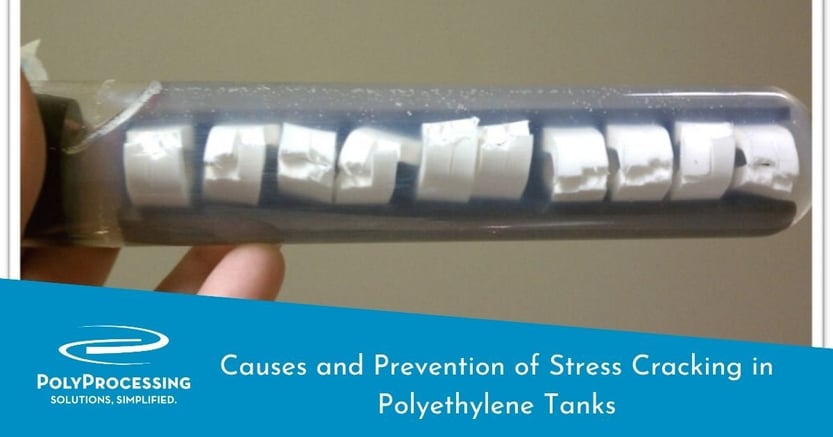
If the tank material isn’t built to resist crack propagation, it can develop leaks and, in a worst case scenario, lead to sudden tank failure. For anyone responsible for safety, compliance, maintenance, or uptime, that risk can be costly.
Stress cracking is one of the main reasons high-density crosslinked polyethylene (HDXLPE or XLPE) is considered a high-performance tank material. Unlike high-density linear polyethylene, or HDPE, HDXLPE has a molecular structure that provides much stronger resistance to stress cracking.

In plain terms, crosslinked polyethylene is far better suited to the service conditions chemical tanks actually face than linear polyethylene.
What Is Stress Cracking?
Environmental stress cracking is a material failure that occurs when physical stress and chemical exposure act together. Cracking is caused by surface-initiated microcracks or fractures, in which stresses and environmental effects combine to accelerate cracking in the polymer.
That combination is important. A tank may be under mechanical stress from normal use and may also be exposed to a chemical or surfactant that interacts with the polymer surface. Separately, each factor may be manageable. Together, they can radically shorten tank life.
The process usually begins at the microscopic level. Small voids or imperfections form in the polymer structure. These voids aren’t always visible from the outside. With repeated stress, chemical exposure, and time, the cracks can connect and grow.
Once crack propagation begins, the tank has lost some of its margin of safety. In many applications, a cracked polyethylene tank should be replaced rather than repaired, because the underlying material has already shown signs of failure.
Stress cracking is rarely caused by a single condition. Usually, several factors play a role — which is why material selection, chemical compatibility, installation, fittings, venting, and operating practices all matter.

Common Causes of Environmental Stress Cracking
Stress cracking is often the result of chemical exposure. Some chemicals are harder on polyethylene than others. Surfactants, soaps, detergents, wetting agents, oxidizers, and certain corrosive chemicals can increase the likelihood of environmental stress cracking.
Chemical concentration and temperature also matter. A tank that performs well at one chemical concentration may not be appropriate at a higher concentration or operating temperature.
Pay attention to temperature swings as well as temperature extremes. Outdoor tanks may see hot days, cold nights, seasonal changes, and UV exposure. Heated chemicals can create additional stress. Polyethylene is tough, but like all plastics, it responds to temperature. Expansion and contraction are normal — the question is whether the tank and its connected system are designed to handle that movement.
Mechanical stress is another major factor. Tanks expand and contract as they are filled and emptied. The liquid weight changes the load on the tank wall. Piping that is not properly supported can pull on fittings. Rigid plumbing can transfer vibration or movement into the tank. A tank installed on an uneven surface can experience localized stress points. Over time, these conditions can create areas where cracking is more likely to begin.
Pressure and vacuum conditions can also contribute to cracking. Polyethylene chemical storage tanks aren’t built to withstand great pressure. If a tank isn’t vented correctly, filling and discharge can create pressure or vacuum that strains the tank. Venting should be treated as part of the storage system, not an accessory.
Installation and handling are also important. Even a strong tank material can be compromised by poor installation. Improper lifting, dragging, inadequate foundations, unsupported piping, and incompatible fittings can all reduce tank life.
Why Linear Polyethylene Tanks Are Vulnerable
Linear polyethylene is common in many storage applications, and it can be practical in the right setting. But in demanding chemical storage, HDPE has a structural limitation: its polymer chains are linear. When a crack begins in a linear material, there is less resistance to continued splitting. In HDPE tanks, mechanical stress can lead to catastrophic failure, and a crack may “unzip” through the material.
With linear polyethylene, the molecular structure doesn’t provide the same internal network of bonds to slow crack growth. Once stress finds a path, the crack can keep moving. That doesn’t mean every HDPE tank will fail, but it does mean HDPE has less built-in protection when the chemical is aggressive, the application is tough, or failure would carry a high cost.
For water or mild materials, HDPE may be acceptable. For more demanding chemical storage, material selection becomes a risk decision.

What Makes HDXLPE a Better Choice
HDXLPE starts with polyethylene, but crosslinking changes the material in a meaningful way. During crosslinking, bonds form between polymer chains. Instead of separate linear chains, the material becomes more like a connected network. These crosslinks tie the polymers together and dramatically increase molecular weight.
That molecular network is why HDXLPE performs so well in chemical storage. HDXLPE has 10 to 20 times the environmental stress crack resistance of HDPE, 10 times the molecular weight, and 3 to 5 times the impact and tensile strength.
Those differences matter in the field. If a crack develops in an HDXLPE tank, the crosslinked polymer chains help prevent the crack from propagating through the tank wall. Instead of behaving like a zipper, the material has a network that resists propagation.
That doesn’t make HDXLPE indestructible or remove the need for proper design. Chemical compatibility, wall thickness, venting, fittings, installation, and operating practices still matter. But HDXLPE gives the storage system a much stronger starting point.
Prevention Starts Before the Tank Is Ordered
The best way to prevent stress cracking is to design the tank system around the chemical and the operating conditions from the beginning. A chemical storage tank should not be treated as a generic container. The right tank depends on the chemical, concentration, temperature, specific gravity, location, fill and discharge method, venting needs, fittings, accessories, and regulatory requirements.
Poly Processing tanks are engineered for the particular chemical they are intended to store. A tank used for one chemical should not automatically be repurposed for another. Even with HDXLPE, changing service requires careful review of chemical compatibility, wall thickness, gaskets, fittings, vents, instrumentation, and safety requirements. In many cases, purchasing a new tank designed for the new chemical is the safer, cost-effective, and more reliable option.
For stress cracking prevention, material selection should be one of your first decisions. If the application involves aggressive chemicals, surfactants, oxidizers, elevated temperatures, or a high consequence of failure, HDXLPE offers a clear advantage over HDPE. Its higher environmental stress crack resistance gives operators more confidence that the tank can handle real-world conditions.
Tank Installation and Operating Discipline
Even the best tank material can be compromised by poor installation. Chemical storage tanks need a flat, properly prepared support surface. Piping should be independently supported so the weight of valves, pumps, and pipe runs does not hang from the tank wall. Flexible connections should be used to allow movement and reduce stress at fittings, especially in the lower third of the tank's sidewall. Restraint systems should be selected and installed correctly, especially in seismic or high-wind areas.

Venting is important, as well. During filling, air and vapor must leave the tank. During discharge, air must enter. If venting is undersized or blocked, the tank can see pressure or vacuum conditions it was never designed to handle. Proper venting helps protect the tank from avoidable mechanical strain.
Routine inspection is another practical prevention tool. Operators should look for signs of crazing, cracking, whitening, bulging, leaks, fitting stress, foundation issues, and plumbing loads. They should also pay attention to process changes.
- Has the chemical concentration changed?
- Has the fill rate increased?
- Has a pump been replaced with a larger one?
- Has the vent been modified?
Stress cracking is often tied to changes that seem minor at the time.
Good documentation helps, too. Keep records of the chemical stored, concentration, temperature, tank age, inspections, maintenance, and modifications. That history makes it easier to confirm whether the tank is still appropriate for the service.
Stronger Material, Lower Risk
Stress cracking is one of the most significant long-term risks in polyethylene chemical storage tanks. It is driven by the combined effects of stress, chemical exposure, temperature, cycling, installation conditions, and time. While HDPE can be suitable for some applications, it does not offer the same resistance to crack growth as HDXLPE.
HDXLPE’s crosslinked molecular structure gives it a major performance advantage. With significantly higher environmental stress crack resistance, greater molecular weight, and stronger impact and tensile properties, HDXLPE is better suited for demanding chemical storage environments where tank integrity is critical. It helps reduce the risk that small cracks will lead to major failures and gives facilities a more durable foundation for safe, reliable storage.
When it’s time for a new chemical tank, start with a tank material designed to resist environmental stress cracking. Pair HDXLPE with proper chemical compatibility review, correct installation, adequate venting, supported piping, and regular inspection, and the entire system is better positioned for long service life.
A chemical storage tank is not the place to cut corners. The cost difference between a basic tank and a better-engineered tank system is small compared with the cost of a failure.
Still have questions? Contact a chemical storage tank expert to get the custom help you need!

Posts By Topic

Tech Talk Podcast Episodes
Subscribe By Email
Recent Posts
- Why One Big Tank Is Your Biggest Risk: The Case for Manifolded Storage
- Why Hydrofluoric Acid Requires Specialized Storage Design
- Causes and Prevention of Stress Cracking in Polyethylene Tanks
- Storing Sodium Chlorite Solution Safely in Industrial Applications
- Join Us at WEFTEC 2026 Conference & Exhibition
Tank Configurator
Find the recommended tank and system components for your chemical storage challenge.
Configure a Tank Package