

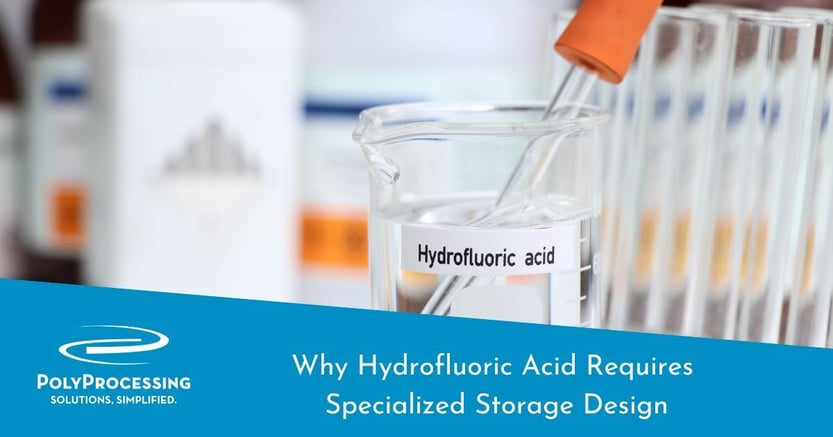
Why Hydrofluoric Acid Requires Specialized Storage Design
Hydrofluoric acid is one of the most widely used industrial chemicals in North America — and one of the most unforgiving. From semiconductor fabrication and metal processing to glass etching and water treatment, thousands of facilities rely on hydrofluoric acid every day.
Yet many of those same facilities underestimate how demanding this chemical is on the equipment that stores it.
Unlike most acids, hydrofluoric acid doesn't make its hazards obvious. It works quietly — attacking materials that would otherwise withstand other corrosive chemicals, penetrating microscopic weaknesses in tank walls, fittings, and welds, and creating exposure hazards that can turn a minor leak into a life-threatening emergency.
That's why hydrofluoric acid storage isn't a place for generic tanks or off-the-shelf chemical storage solutions. It requires a purpose-built storage system, engineered from the ground up for this specific chemical.
In this article, we'll examine what makes hydrofluoric acid uniquely dangerous, why conventional storage materials fall short, and how a properly designed crosslinked polyethylene tank system protects your people, your facility, and your bottom line.
What Makes Hydrofluoric Acid Different?
Hydrofluoric acid forms when hydrogen fluoride dissolves in water. For practical purposes, the two are treated as the same chemical. It's used extensively to extract, process, and refine metals, rock, brick, and oil. It etches, polishes, and frosts glass. It's essential to the manufacturing of silicon semiconductor chips, and it appears in commercial rust removers, automotive cleaners, and water spot removers. In wastewater treatment, hydrofluoric acid reduces pH, breaks emulsions, and is strong enough to remove scale and rust from treatment pipes.
That versatility comes with a dark side. Hydrofluoric acid is fundamentally different from other mineral acids in two critical ways.
First, it attacks materials other acids can't touch. Hydrofluoric acid is one of the few chemicals that dissolves glass and silica-based materials. That immediately rules out glass-lined storage vessels and creates serious problems for fiberglass-reinforced plastic (FRP) tanks, where the acid can wick into the glass fibers and compromise the tank's structural integrity from within. Even many metals that resist other acids will corrode in hydrofluoric acid service.

Second, the acid’s health hazards are uniquely severe. Hydrofluoric acid penetrates tissue more quickly than other acids, and toxicity can occur through skin or eye contact, inhalation, or ingestion. Most alarming, hydrofluoric acid alters nerve function—meaning a worker exposed to a leak may not feel the burn until significant damage has already occurred, increasing the extent of injury. Once absorbed through the skin, the fluoride ion reacts with calcium in the blood and can trigger cardiac arrest. There is simply no margin for error.
When a chemical can silently destroy both your storage equipment and the people working around it, there’s no such thing as “good enough” storage. Every component of the system — the tank material, fittings, gaskets, bolts, and containment strategy — must be selected and engineered specifically for hydrofluoric acid.
Related: The Best Tanks For Storing Corrosive Chemicals

Why Conventional Tank Materials Fall Short
Facilities storing hydrofluoric acid have historically struggled to find materials that can withstand the chemical over the long term.
Carbon and stainless steel require expensive specialty coatings or exotic alloys to resist hydrofluoric acid, and every weld and seam is a potential point of attack. When a coating fails — and they do — corrosion begins immediately, often out of sight.
Fiberglass-reinforced plastic (FRP) is particularly vulnerable. Because hydrofluoric acid attacks glass, any breach of the resin barrier allows the chemical to wick into the structural fibers, degrading the tank from the inside out. FRP also requires careful handling to prevent cracking and ongoing maintenance and inspection.
Standard linear polyethylene (HDPE) offers better chemical compatibility than steel or FRP. Still, it lacks the structural robustness that this hazardous chemical demands, especially at higher specific gravity ratings and for the long service life required for hydrofluoric acid storage.
This is where high-density crosslinked polyethylene (XLPE) changes the equation.

The XLPE Advantage for Hydrofluoric Acid
Crosslinked polyethylene is a thermoset resin in which bonds form between the polymer chains themselves — bonds equal in strength to the polymer backbone. This dramatically increases molecular weight and produces physical properties that linear polyethylene cannot achieve. Compared to HDPE, Poly Processing's XLPE delivers:
- 10–20 times the environmental stress-crack resistance
- 10 times the molecular weight
- 3–5 times the impact and tensile strength
Just as important, XLPE tanks are molded as seamless, one-piece vessels. There are no welds, seams, or mechanical joints in the tank wall for hydrofluoric acid to exploit. And because XLPE is inherently resistant to hydrofluoric acid, there are no coatings or liners to maintain, inspect, or replace.
For hydrofluoric acid service, Poly Processing engineers a complete system around the chemical: a 1.9 specific gravity XLPE tank paired with the proper fittings, gaskets, and bolts, because a tank is only as reliable as its weakest wetted component.
A standard gasket or the wrong bolt alloy can undermine an otherwise perfect tank. Poly Processing provides comprehensive storage solutions for hydrofluoric acid from under 30% up to 70% concentration. Hydrofluoric acid is an NSF/ANSI 61-approved chemical for Poly Processing tank systems at concentrations of 52% or less — a critical certification for potable water treatment applications.

Secondary Containment: The SAFE-Tank® System
Because of hydrofluoric acid's hazardous and highly corrosive nature, secondary containment is absolutely essential. The question is how to achieve it without doubling your footprint or leaving your containment open to rainwater, debris, and accidental contact.
Poly Processing's SAFE-Tank® system addresses this challenge with its "tank within a tank" design. The fully enclosed secondary containment vessel provides 110% containment within the same footprint as a standard vertical tank. If the primary tank is breached, the chemical is safely contained within a closed system — designed so the chemical can’t be exposed to personnel, released into the environment, or contaminated by rainwater that could hinder cleanup and disposal.
For a chemical whose vapors and splashes are as hazardous as hydrofluoric acid, enclosed containment is one of the most meaningful safety upgrades a facility can make—especially when tanks are located in close quarters or near work areas.

Reducing Human Exposure: The IMFO® Tank
If your facility already has containment in place, Poly Processing's IMFO® (Integrally Molded Flanged Outlet) tank offers another path to safer hydrofluoric acid storage — one designed to minimize the hands-on maintenance that puts workers at risk.

Unlike tanks with metallic flanges inserted during or after production — a cost-saving shortcut that creates leak risks — the IMFO flange is molded as an integral part of the tank from the same material as the tank itself. It's a stress-free component of the vessel, not a weak point.
For hydrofluoric acid service, the IMFO design delivers several key advantages:
- Full tank discharge. The flange sits at the bottom of the sidewall, below the tank knuckle radius, allowing the tank to discharge completely. No one should ever need to enter the tank for cleaning — eliminating one of the most dangerous confined-space exposures imaginable when working with this chemical.
- Preserved structural integrity. Because the flange doesn't penetrate or compromise the tank's hoop integrity, the vessel has a longer useful life.
- External, accessible maintenance. The entire flange system is external and extends away from the tank wall, so inspections and maintenance happen safely outside the vessel.
- Superior static head pressure. The IMFO design provides the highest net positive suction head of any vertical non-coned tank on the market.
Both vertical and sloped-bottom IMFO configurations are available, providing engineers with flexibility to match the tank to the application.

The Real Cost of Getting It Wrong
It can be tempting to treat tank purchasing as a commodity decision — but with hydrofluoric acid, the true cost of a storage failure goes far beyond replacing a tank. A single leak can result in an injured employee, an emergency response, regulatory scrutiny, environmental remediation, and unplanned downtime that ripples through your entire operation.
Measured against those risks, a properly engineered storage system is a critical investment — and it typically delivers a lower total cost of ownership through reduced maintenance and a longer service life.
Store Hydrofluoric Acid with Confidence
Hydrofluoric acid demands respect and a storage system engineered specifically for its unique chemistry and hazards. With decades of rotational molding expertise, XLPE tank systems backed by a full five-year warranty, and complete chemical-specific engineering — from tank resin to the last bolt — Poly Processing helps facilities across every industry store hydrofluoric acid safely and with confidence.
Ready to design the right hydrofluoric acid storage system for your facility? Talk to a Poly Processing chemical storage expert or request a quote.

Posts By Topic

Tech Talk Podcast Episodes
Subscribe By Email
Recent Posts
- Why Hydrofluoric Acid Requires Specialized Storage Design
- Causes and Prevention of Stress Cracking in Polyethylene Tanks
- Storing Sodium Chlorite Solution Safely in Industrial Applications
- Join Us at WEFTEC 2026 Conference & Exhibition
- Why Poly Processing's BABA Certification Matters for Your Project
Tank Configurator
Find the recommended tank and system components for your chemical storage challenge.
Configure a Tank Package