

Can Stainless Steel Be Used for Corrosive Chemicals?
It is one of the most common questions we hear from customers specifying a new chemical storage system, and the honest answer is: sometimes, but far less often than most people assume.
If the tank material isn’t built to resist crack propagation, it can develop leaks and, in a worst case scenario, lead to sudden tank failure. For anyone responsible for safety, compliance, maintenance, or uptime, that risk can be costly.
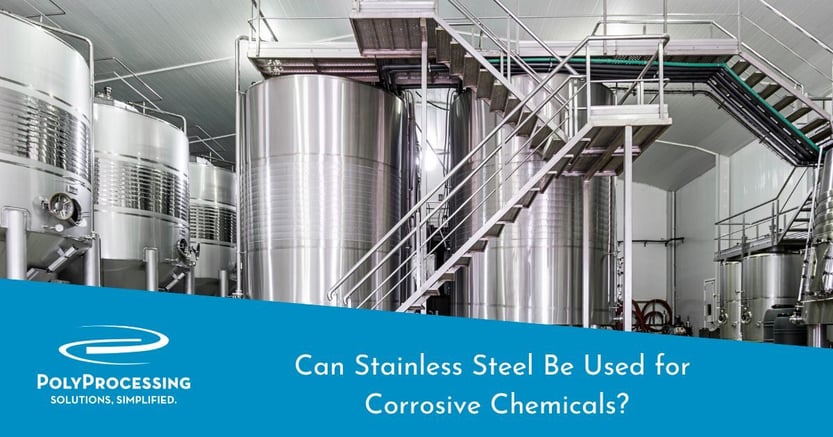
Stainless steel has an outstanding reputation, and much of it is deserved. It is strong, it handles heat and pressure that would destroy most other materials, it looks impressive, and it has been the default choice in certain industries for generations. That reputation, though, has a way of extending into applications where stainless is genuinely the wrong tool—and where the consequences show up years later as pitting, cracking, and premature replacement.
The truth is that stainless steel occupies a real but narrow niche in chemical storage. Understanding where that niche begins and ends is the difference between a storage system that performs for decades and one that becomes a maintenance liability. Let's look honestly at both sides.

Where Stainless Steel Genuinely Excels
Some applications call for stainless steel, and it would be disingenuous to suggest otherwise.
High-temperature service. This is stainless steel's clearest advantage. High-density crosslinked polyethylene is engineered to handle temperatures up to roughly 150°F depending on the material being stored — meaningfully better than standard linear polyethylene, but still a ceiling. Stainless steel operates comfortably at temperatures much higher than that. If your process involves sustained elevated temperatures well beyond the polyethylene range, stainless can be the appropriate material and no amount of engineering around the edges changes that.
Pressure applications. Polyethylene chemical storage tanks are not pressure vessels. This is a foundational design principle, not a limitation to be worked around. XLPE tanks are designed to operate at atmospheric pressure — no positive pressure, no vacuum. Stainless steel, by contrast, can be engineered and code-stamped as a true pressure vessel. If your application genuinely requires internal pressure, stainless is the correct specification.
Mechanical and structural demands. Applications involving high-speed agitation, significant mechanical loading, mounted equipment, or aggressive abrasion may favor steel's rigidity and strength.
Aesthetics and public-facing installations. Breweries, food and beverage production floors, pharmaceutical suites, and other spaces where equipment is on display often specify stainless for its clean, polished appearance. That is a legitimate design consideration.
If your application checks one of those boxes — particularly sustained high heat or true pressure service — stainless steel deserves serious consideration. If it does not, the calculus changes considerably.
The Chemical Resistance Problem
Here is where the reputation and the reality diverge most sharply. "Stainless" is a description of appearance under ordinary conditions, not a guarantee of chemical inertness.
Stainless steel resists corrosion because of a thin passive chromium oxide layer that forms on its surface. That layer is remarkably effective — until something disrupts it. And a great many of the chemicals stored in industrial and municipal facilities do exactly that.
Chlorides are the most notorious offenders. Sodium hypochlorite, the workhorse disinfectant of the water treatment industry, attacks stainless steel aggressively. It penetrates the passive layer and initiates pitting corrosion, which is particularly dangerous because it concentrates damage into narrow, deep points rather than distributing it across the surface. A tank wall can retain most of its thickness and still develop a through-wall pit. Hydrochloric acid is similarly destructive to most common stainless grades.
Sulfuric acid presents a concentration-dependent problem that catches specifiers off guard. Mild steel performs adequately with 98% concentration sulfuric acid, which is why it remains common in mining. But once the concentration drops below roughly 93% — through dilution, through moisture absorption, through normal operational variation — the acid becomes corrosive to steel and tank life expectancy falls off sharply. Chemical storage conditions in the real world are rarely as stable as the specification assumed.
Then there are the failure modes specific to metals. Crevice corrosion attacks the tight spaces around gaskets, fittings, and lap joints where stagnant chemical sits and oxygen is depleted. Chloride stress corrosion cracking can propagate through a stainless wall under the combined influence of tensile stress, chlorides, and elevated temperature — often with little visible warning before failure. Galvanic corrosion occurs wherever dissimilar metals meet in the presence of an electrolyte.
And critically, stainless steel tanks are welded. A 6,000-gallon stainless steel tank can contain up to 70 yards of welded seams. Every one of those inches represents a heat-affected zone where the metallurgy has been altered, where chromium can be depleted, and where corrosion preferentially initiates. Welds are where stainless tanks tend to fail first, and inspecting and maintaining 70 yards of seam is a genuine long-term burden.
The workaround is to specify a higher alloy — 316L instead of 304, or a duplex or super-austenitic grade for severe service. These do perform better. They also escalate cost substantially, extend lead times further, and still do not make the tank immune to the chemicals that matter most in water treatment.
By contrast, crosslinked polyethylene does not corrode. There is no passive layer to break down, no pitting mechanism, no stress corrosion cracking, and no galvanic couple. Harsh chemicals cannot seep or wick into a high-density XLPE tank wall the way they penetrate fiberglass laminate or attack a metal surface. The resistance is inherent to the material rather than dependent on a fragile surface film.

The Cost Problem
Stainless steel tanks typically cost two to three times more than a comparable crosslinked polyethylene tank, and in many configurations the gap is wider still — crosslinked polyethylene tanks often deliver equivalent performance at roughly a quarter to a third of the cost of steel.
That initial figure understates the real difference, because the stainless purchase price is only the beginning. Higher alloy grades for corrosive service add significant cost. Secondary containment usually means building a concrete berm or dike, which brings its own capital expense, footprint requirement, chemically resistant coating, and ongoing maintenance and recoating obligations. Stainless systems often require passivation treatment, periodic weld inspection, and repair of any surface damage that compromises the passive layer. Add the cost of any premature replacement driven by pitting or cracking, and the lifetime economics look very different from the quote.
Polyethylene inverts most of that. There is no coating program, no passivation, no weld inspection, and no painting required — UV stabilizers are integrated throughout the tank wall rather than applied to the surface. Maintenance is minimal. And with an integrally molded double wall system, secondary containment comes built into the tank rather than poured around it.
The Lead Time Problem
For many projects, this is the factor that decides the specification.
Stainless steel tanks are fabricated to order, and current market lead times commonly run 30 weeks or more. Most FRP and steel manufacturers quote delivery windows in the 24 to 40 week range. On a capital project with a committed construction schedule, a compliance deadline, or a plant expansion tied to production commitments, a seven-month tank delivery is not a minor inconvenience — it drives the entire critical path.
Poly Processing's rotational molding process operates on a fundamentally different timeline. XLPE tanks typically deliver in seven to nine weeks, and the company consistently delivers complete systems within eight to ten weeks. For a utility facing a regulatory deadline or a manufacturer scaling capacity to meet demand, that difference of five or six months is often worth more than any other factor in the comparison.
Emergency replacement makes the contrast even starker. When a tank fails unexpectedly, a facility cannot wait 30 weeks. It needs a replacement in the ground and back in service, and only one of these materials can realistically deliver that.

Why Poly Processing Tanks Are the Better Choice in Most Applications
Crosslinked polyethylene is not a budget substitute for stainless steel. It is a thermoset material specifically engineered for chemical storage, and in the applications that make up the overwhelming majority of the market, it is simply the better engineering choice.
Poly Processing tanks are rotationally molded as seamless, one-piece, homogenous vessels. There are no welds, no laminated layers, and no assembled joints — which eliminates the weak points where corrosion and leaks typically begin. Durability testing has included dropping semi-filled tanks from 45 feet without structural failure.
Failure behavior matters as much as failure resistance. In controlled pressure testing to failure, a linear polyethylene tank came apart catastrophically at 9 psi, releasing its entire contents in a sudden, uncontrolled event. A crosslinked polyethylene tank pressurized to 10 psi developed a 6-to-8-inch crack at the top but did not break apart — the crosslinked polymer chains around the crack held the tank together and contained the release. A contained leak is a manageable maintenance problem. A tank that comes apart is not.
For aggressively oxidizing chemicals, the OR-1000™ engineered resin system adds a polyethylene layer specifically formulated to resist oxidation between the chemical and the structural XLPE wall. The two surfaces are molecularly bound together during rotomolding, creating a seamless bond that cannot delaminate, blister, or peel the way an applied liner or coating can. The result is four times the antioxidant strength of any polyethylene on the market, covering all wetted surfaces — including the face of the IMFO® drain. In practice, an antioxidant barrier can more than double the service life of a tank system.

For containment, the SAFE-Tank® double wall system provides at least 110% secondary containment in a tank-within-a-tank configuration. It eliminates the cost, footprint, and maintenance of a concrete berm. If the primary tank ever develops a leak, the chemical is contained in the interstitial space, the liquid level equalizes, and the chemical remains usable — allowing operations to continue until a repair can be scheduled rather than forcing an emergency shutdown. It delivers the same corrosion resistance customers seek from stainless, with benefits stainless cannot match.

The IMFO® Integrally Molded Flanged Outlet is molded as part of the tank itself, positioning the flange below the knuckle radius for full drainage and eliminating the stress points and leak paths created by fittings added after production.

Poly Processing is also the only chemical storage tank manufacturer with complete NSF/ANSI 61 system certification, covering 38 of the most popular water treatment chemicals across XLPE tanks, OR-1000 systems, and all associated fittings — not just the tank shell in isolation. Tanks are available from 55 gallons to 15,500 gallons, with specific gravity designs up to 2.2.

Making the Right Call
The decision framework is straightforward. If your application requires sustained temperatures beyond the polyethylene range, or if it genuinely requires a pressure vessel, specify stainless steel and engineer it properly for the chemical involved. Those are real requirements and stainless meets them.
For everything else — and that covers the large majority of corrosive chemical storage in water treatment, industrial processing, power generation, food and beverage, and municipal infrastructure — the questions worth asking are whether the material will still resist your chemical in year twenty, what the total cost of ownership looks like once containment and maintenance are included, and whether your project schedule can absorb a 30-week lead time.
Stainless steel earns its place in a narrow set of applications. Outside that niche, crosslinked polyethylene delivers equal or better chemical resistance at a fraction of the cost, in a fraction of the time, with far less to maintain.
To determine which solution fits your specific chemical, temperature range, and operating conditions, talk to a Poly Processing chemical storage tank expert or use the Tank Configurator to identify recommended tanks and system components for your application.

Posts By Topic

Tech Talk Podcast Episodes
Subscribe By Email
Recent Posts
Tank Configurator
Find the recommended tank and system components for your chemical storage challenge.
Configure a Tank Package