

The Unsung Equipment Behind Data Center Uptime: Chemical Storage
Ask anyone what keeps a data center alive, and you'll hear the same short list: redundant power feeds, battery banks, diesel generators, and the chillers that keep rack inlet temperatures where they belong. Nobody mentions a high-density crosslinked polyethylene tank sitting on a containment pad near the cooling yard.
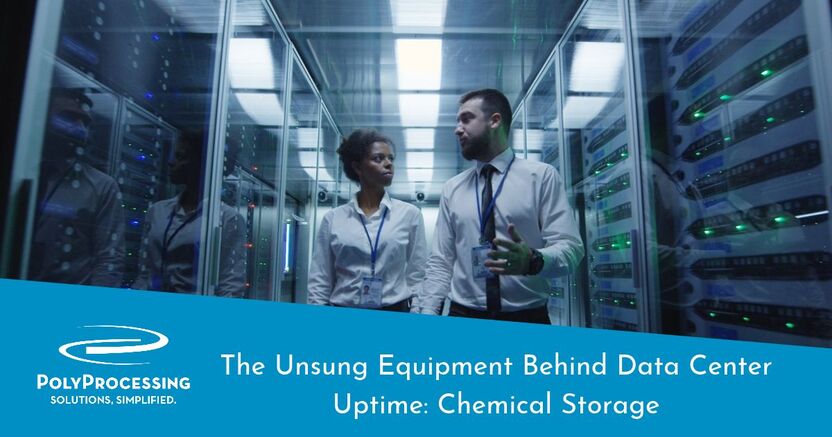
Yet if that tank fails—or if the chemical inside has been quietly degrading because the vessel was never the right material for the job—the consequences climb the stack fast. Fouled heat exchangers. Reduced cooling capacity. A thermal event in a white space full of equipment that can't be replaced on short notice.
Chemical storage is infrastructure. It just happens to be the part of the infrastructure that rarely gets a line item in the uptime conversation.

Start With the Failure, Not the Feature
It's worth walking the failure path backward, because it explains why tank material selection deserves more scrutiny than it usually gets.
A cooling tower loop runs continuously, exposed to open air, concentrating minerals with every evaporation cycle. Left untreated for even a short stretch, it grows biofilm, deposits scale on heat transfer surfaces, and begins eating the steel and copper it touches. The chemical feed program is the only thing standing between that loop and a measurable loss of thermal efficiency. That program depends on accurate dosing. Accurate dosing depends on chemical that is still at the concentration the label promised. And chemical concentration depends on a storage vessel that hasn't leached, absorbed, oxidized, or reacted with what's inside it.
Swap in the wrong tank material and you haven't created an obvious problem. You've created a slow one — a treatment program that drifts out of spec, a cooling system that loses a few points of efficiency, and eventually a maintenance window nobody planned for. In a facility where downtime costs tens of thousands of dollars per minute, slow problems are expensive problems.
That's the argument for high-density cross-linked polyethylene, and it's a more interesting argument than a spec sheet.

A Data Center Is a Water Treatment Plant with Servers Attached
The scale of the chemical inventory surprises people who haven't toured the back-of-house side of a hyperscale campus. Three separate water systems run in parallel, and each one carries its own treatment burden.
The cooling tower loop is the most chemically demanding by a wide margin. Because it's open to the atmosphere and constantly concentrating, it needs biocides — sodium hypochlorite, chlorine dioxide, and similar oxidizers — to suppress bacteria, algae, and biofilm. It needs scale inhibitors such as phosphonates and polyacrylates to keep mineral deposits off the heat exchangers where even a thin film degrades thermal performance. It needs corrosion inhibitors like orthophosphate, molybdate, and zinc compounds to protect mixed-metal piping. It also needs dispersants, typically acrylic polymers, to keep suspended solids in motion long enough for filtration to catch them. Each of those products must be on site, in volume, feeding automated dosing equipment that never stops.
The closed-loop chilled water system is quieter. Sealed circulation means far less chemical turnover, but corrosion inhibitors — sodium nitrite, sodium molybdate — still matter, because oxidation inside sealed piping is a decade-long problem rather than a weekly one.
The two chemistries at the heart of modern data center liquid cooling both pair naturally with crosslinked polyethylene tanks. Propylene glycol and water blends—most commonly a 25% mix such as PG25, often with corrosion and scale inhibitors added—are the workhorse fluid for direct-to-chip systems and rear-door heat exchangers. Ethylene glycol and water blends, by contrast, dominate closed outdoor-facing loops such as chillers and intermediate free-cooling circuits, where their superior heat transfer efficiency outweighs the handling precautions required by their toxicity, keeping them segregated from the server-facing inner loops.
Then there's wastewater, where the chemical list gets long. Cooling tower blowdown, reverse osmosis reject, battery room neutralization, equipment washdown, fire pump testing, and HVAC condensate all converge into a process stream that cannot legally reach the municipal sewer until it's been conditioned. Sulfuric acid, hydrochloric acid, sodium hydroxide, and calcium hydroxide pull pH back into the 6-to-9 window regulators require. Coagulants and flocculants — ferric chloride, aluminum sulfate, cationic polymers — bind suspended solids and dissolved metals into something a clarifier or filter can capture. Sodium bisulfite and sodium metabisulfite strip residual oxidizers. Sodium sulfide and ferrous sulfate precipitate heavy metals. Hydrogen peroxide and sodium hypochlorite handle bacterial activity and sulfide odor in holding tanks.
Line them up and you have acids next to caustics next to strong oxidizers next to polymers, all stored within the footprint of a facility whose most valuable asset is sensitive electronic equipment. That's the real storage challenge — not any single chemical, but the range.

What Cross-Linking Actually Changes
Standard high-density polyethylene is a linear polymer. The chains sit alongside one another, held by nothing more than physical entanglement. It's a perfectly good material for many applications and a marginal one for aggressive chemistry.
Cross-linked polyethylene is chemically bonded during the molding process, tying those chains into a three-dimensional network. That single change in molecular architecture produces a material with a different performance envelope: significantly better chemical resistance, higher impact strength, a broader usable temperature range, and — most importantly for anyone storing oxidizers — dramatically improved resistance to environmental stress cracking.
Stress cracking deserves its own paragraph, because it's the failure mode most people underestimate. In linear HDPE, residual stresses left over from molding combine with chemical exposure to nucleate microscopic cracks. Those cracks don't announce themselves. They propagate over months and years until the tank weeps, then leaks, then fails. Cross-linking largely eliminates the mechanism. For a facility where a corrosive release near electrical infrastructure is genuinely catastrophic, removing that failure path is worth more than any other single specification.
HDXLPE tanks are also rotationally molded as a single seamless piece. No welds, no joints, no bonded seams — which matters, because fabricated tanks overwhelmingly fail at exactly those locations. And the material is tough enough to absorb the realities of an operating facility.

One Material Across the Whole Chemical Program
Here's the operational advantage that gets overlooked. Because HDXLPE is compatible with essentially the full range of chemicals a data center uses — hypochlorite, sulfuric acid, caustic, ferric chloride, bisulfite, and the rest — operators don't have to maintain a patchwork of tank materials matched chemical by chemical.
That consolidation pays off in ways that show up on the operations budget rather than the capital budget. Procurement is simpler. Spare fittings, gaskets, and accessories are interchangeable. Technician training covers one system instead of four. And the risk of someone connecting the right chemical to the wrong tank drops considerably.
For the most aggressive oxidizers, there's another layer available. Poly Processing's OR-1000™ System places an engineered resin barrier between the cross-linked polyethylene and the chemical itself, specifically to counter the oxidative attack that sodium hypochlorite, sulfuric acid, and hydrochloric acid inflict on tank walls over time. In a facility with continuous hypochlorite feed, that barrier translates directly into additional years of service life.

Where the Tanks Actually Sit
In cooling tower treatment, HDXLPE bulk tanks and day tanks hold the biocides, scale inhibitors, and corrosion inhibitors feeding automated metering pumps. Bulk vessels — anywhere from a few hundred to several thousand gallons depending on water consumption and dosing rates — are replenished on scheduled deliveries. Smaller day tanks act as the intermediate buffer between bulk storage and the pumps themselves.
In pH neutralization, HDXLPE tanks hold the concentrated acids and caustics used to condition wastewater. These are the harshest duties in the building, and they're typically installed inside secondary containment berms or drip containment structures to satisfy EPA and local hazardous storage requirements.

In equalization and holding service, larger vessels buffer variable wastewater flow so downstream treatment sees consistent chemistry instead of slugs. Chemical feed skids — standard equipment on hyperscale wastewater systems — commonly use HDXLPE day tanks for dechlorination agents and coagulants.
And in inventory strategy, bulk HDXLPE storage lets a facility carry a meaningful reserve of critical treatment chemicals. That's not a small point in an era of unpredictable supply chains. A delivery delay shouldn't interrupt a water treatment program, and with adequate on-site storage, it can't.
Hold Storage to the Same Standard as the Rest of the Stack
Nobody would accept a UPS with an unknown service life or a generator that might need replacement in five years. Chemical storage should meet the same bar, because it sits on the same critical path. Compatibility across the entire chemical inventory. Structural integrity in a facility where a release is unacceptable. A service life measured in decades, not warranty periods. Compliance-ready containment. Minimal maintenance demand, because data center operations teams run lean and have no capacity to babysit tanks.
HDXLPE meets that standard, which is why it keeps showing up in facilities where the cost of being wrong is enormous.
Demand isn't easing, either. Cloud growth and AI workloads are pushing rack densities and cooling loads higher every quarter, and higher cooling loads mean more water, more chemistry, and more storage. The facilities being designed right now will run harder than anything built a decade ago. The storage infrastructure underneath them needs to be specified accordingly.
Ready to pressure-test your chemical storage plan? Talk to a Poly Processing chemical storage expert about how HDXLPE tank systems fit your data center's treatment program.

Posts By Topic

Tech Talk Podcast Episodes
Subscribe By Email
Recent Posts
- The Unsung Equipment Behind Data Center Uptime: Chemical Storage
- Can Stainless Steel Be Used for Corrosive Chemicals?
- Sodium Hypochlorite Tank Containment for Spill Control
- Why One Big Tank Is Your Biggest Risk: The Case for Manifolded Storage
- Why Hydrofluoric Acid Requires Specialized Storage Design
Tank Configurator
Find the recommended tank and system components for your chemical storage challenge.
Configure a Tank Package