

Compliance & Regulations for Chemical Storage Tanks
When purchasing a chemical storage tank, it can feel overwhelming to navigate the landscape of industry standards and regulatory requirements. From material testing protocols to federal safety mandates, the compliance considerations are numerous — and the stakes can be high. A misstep can mean choosing a tank that fails prematurely, exposes workers to hazardous chemicals, or runs afoul of federal and state regulations.
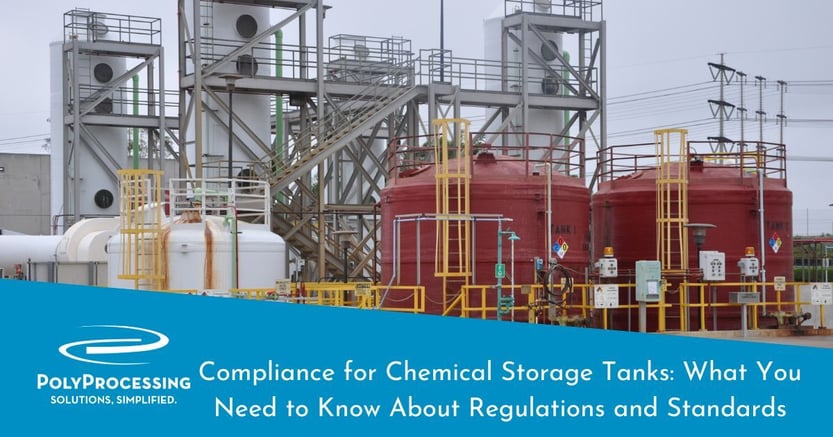
This article brings together an overview of the most important compliance frameworks you need to understand: ASTM D-1998, NSF/ANSI/CAN-61, FDA, OSHA, and IBC seismic and wind restraint standards.
This isn't an exhaustive list of all compliance regulations on the books, but it will give you a solid, well-informed starting point for evaluating your chemical storage tank purchasing options.
ASTM D-1998 Is the Foundation of Polyethylene Tank Quality
When it comes to polyethylene storage tanks, outward appearances can be deceiving. Two tanks may look virtually identical on the surface while differing dramatically in construction quality, material integrity, and long-term reliability.
Many buyers don't realize that specific standards govern tank construction — and that not all manufacturers follow them or meet them.
ASTM D-1998 is the benchmark standard for polyethylene upright storage tanks. The standard stipulates that tanks and their materials undergo a series of critical tests to evaluate strength and structural integrity. For cross-linked polyethylene (XLPE) tanks specifically, an additional test assesses the chemical composition of the materials used.

Together, these assessments are designed to ensure that you receive a durable, safe, and reliable chemical storage solution that performs as expected over time.
Before investing in a polyethylene chemical tank, it's essential to confirm that the manufacturer fully complies with ASTM D-1998 specifications. Never purchase a chemical storage tank without requesting access to the manufacturer's hoop stress data, asking how the tank's stress is measured, and reviewing the designed wall-thickness data sheets. These technical documents, validated by the manufacturer, serve as proof that the tank meets stringent industry standards.

It's tempting to choose a lower upfront cost for your chemical storage tank, but cutting corners here can lead to significant financial repercussions if a tank fails or reaches the end of its useful life earlier than expected.
Your most valuable asset is knowing what you’re getting into before you make a purchase. Understanding ASTM D-1998 will help separate a sound investment from a bad one. Make sure you can confidently purchase a high-performing, reliable tank and avoid an inferior product that could cost far more in the long run.
NSF/ANSI/CAN-61 Protects Potable Water Systems
If your business manufactures, sells, or distributes water treatment products in North America (including Canada), compliance with NSF/ANSI/CAN-61 is typically required by law. This standard protects public health by preventing toxic leaching from water system components into drinking water supplies. Developed by the National Sanitation Foundation (NSF) and the American National Standards Institute (ANSI), it sets rigorous testing criteria for equipment that comes into contact with potable water.

Testing under NSF/ANSI/CAN-61 involves evaluating equipment using water at different pH levels. For chemical storage tanks, the standards are even more stringent — tanks must be tested with chemicals certified to NSF/ANSI/CAN-60, and then assessed after chemical exposure to detect any harmful leachants. The goal is to ensure that nothing dangerous migrates from the tank material into the water supply under real-world conditions.

One of the most common compliance pitfalls is confusion about what exactly needs to be certified. It's not enough for the tank itself to carry NSF/ANSI/CAN-61 certification — every fitting, gasket, and accessory in the system must also meet the standard for the entire system to be considered compliant. Purchasing a certified tank and pairing it with non-certified fittings will leave you out of compliance, a mistake that can be costly to correct after installation.

Poly Processing takes a full-system approach to NSF/ANSI/CAN-61 certification, ensuring that tanks, fittings, gaskets, and all accompanying components meet the required standards. Poly Processing currently holds NSF/ANSI/CAN-61 certification for 38 popular water treatment chemicals in its XLPE tank systems, including options featuring the OR-1000™ engineered antioxidant system for enhanced safety. Tanks are available for both potable water and chemical storage applications.
For certification details and the specific chemical concentrations a component is certified to handle, the NSF website is the authoritative resource.

Polyethylene Tanks in Food and Beverage Applications
Stainless steel has long been the default choice for storage tanks in the food and beverage industry, largely because of historical concerns about leaching and bacterial growth associated with plastics. However, advances in resin technology have shifted the balance, and high-quality polyethylene tanks are now a viable — and often more economical — alternative for many food-grade applications.
The FDA and the Code of Federal Regulations (CFR) set forth specific guidelines for food and beverage storage under Title 21, Parts 176–177, which outline acceptable materials and compositions for storage tanks. Although the FDA does not inspect these storage systems, it is the responsibility of individual companies to adhere to these guidelines and ensure their systems are compliant.
Poly Processing manufactures polyethylene storage tanks with resins that meet FDA and CFR regulatory standards. Industry leaders rely on Poly Processing's seamless, economical polyethylene tanks as a cost-effective alternative to stainless steel.
Applications span a wide range, including wine and beer storage, clean-in-place (CIP) systems, condiment processing, brining, salt storage, cheese processing, pH adjustment for water treatment, drinking water storage, and ingredient mixing.

For food and beverage businesses seeking a compliant storage solution that doesn't sacrifice budget or performance, polyethylene tanks deserve serious consideration — provided the manufacturer can demonstrate full FDA/CFR compliance for the specific resins used.
OSHA Regulations Keep Your Workplace Safe
The Occupational Safety and Health Administration (OSHA) has established regulations governing the storage of chemicals in tanks, with one central goal: protecting workers' safety and health. Key OSHA requirements for chemical storage tanks include proper labeling of hazardous materials, mandatory employee training, and maintaining Safety Data Sheets (SDSs) for all hazardous chemicals stored on site.
Employers are also required to implement measures that actively prevent chemical spills and releases, ensuring that storage tanks are constructed, maintained, and operated to minimize the risk of exposure or harm.
An important yet often overlooked aspect of OSHA compliance is the role of state-level regulations. Beyond federal OSHA standards, many states have enacted their own chemical storage rules that can be significantly stricter than federal requirements. State regulations may require specific inspection intervals, additional employee training, or enhanced safety features for storage tanks. As a result, a facility fully compliant with federal OSHA standards may still be out of compliance in a given state.
Businesses must be aware of both federal and state requirements and prepared to adapt their protocols based on their operational locations. Engaging directly with local regulatory agencies is one of the most reliable ways to stay current on any additional requirements that apply to your specific facility and the chemicals you store.

IBC Seismic and Wind Restraints
The International Building Code (IBC) provides the framework for designing seismic and wind restraint systems for chemical storage tanks — an often-overlooked compliance area that can have serious safety implications in regions prone to seismic activity or severe weather.
Unlike rigid stainless steel and fiberglass tanks, which are more brittle and less capable of absorbing dynamic forces, polyethylene tanks are ductile by nature. This makes them inherently less susceptible to structural damage during earthquakes or high-wind events. Even so, proper restraint systems are critical and must be designed based on specific variables, including tank size, fluid weight, geographic location, and the type of chemical being stored.
Poly Processing adheres to the latest IBC standards in designing restraint systems for its tanks. Steel clips are typically used to secure the tank to the surrounding structure, and unlike fiberglass tanks — where molded clips can conceal structural damage — the separate steel restraint systems on polyethylene tanks make inspections straightforward and transparent.
Concrete pad design is another critical element of IBC compliance. Pads must meet specific size and strength requirements to properly support both the tank and its restraint system. For facilities using Poly Processing's Integrally Molded Flanged Outlet® (IMFO®) tanks, pad notching is recommended to facilitate easy drainage without interference from the pad design.

With more than 30 years of experience in seismic and wind calculations, Poly Processing brings deep expertise to this area and offers guidance to engineers and contractors to ensure all installations meet IBC requirements for their specific locations and conditions.
Compliance for Chemical Storage Tanks: What You Need to Know About FDA/OSHA/IBC
Compliance Is an Investment, Not a Burden
Navigating compliance for chemical storage tanks is complex, but it's also non-negotiable. The good news is that working with an experienced, knowledgeable tank manufacturer can simplify the process considerably.
Poly Processing has spent more than five decades at the forefront of chemical storage tank design and manufacturing, developing expertise across all of these compliance areas. From FDA-compliant resins used by major food and beverage companies to full-system NSF/ANSI/CAN-61 certification covering tanks, fittings, and gaskets, Poly Processing's approach is built around helping you achieve and maintain compliance with confidence.
When evaluating your next chemical storage tank purchase, don't make compliance an afterthought. Ask the right questions, demand the documentation, and partner with a manufacturer who can back their products with technical data and certifications.
Make sure your chemical storage system is designed right — talk to a chemical storage engineer today.

Posts By Topic

Tech Talk Podcast Episodes
Subscribe By Email
Recent Posts
- Flexible Connectors & Isolation Valves: Proper Installation
- Why ASTM D-1998 Still Matters: The Standard That Separates Serious Tank Manufacturers from the Rest
- Brine Storage Tank Solutions: Material and Manufacturing
- Understanding Pressure Limits in Polyethylene Chemical Storage Tanks
- Easy Level Monitoring with the Reverse Float Level Gauge
Tank Configurator
Find the recommended tank and system components for your chemical storage challenge.
Configure a Tank Package