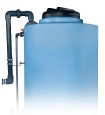
With some chemicals, it’s critical to keep them cool because they will lose their concentration when they heat up. Sodium Hypochlorite is a prime example of that. As it heats up, it starts to lose its strength, and it begins to release gas and free radicals. Its strength can diminish dramatically with heat and UV. So it’s important to keep the chemical as cool as possible from the moment it arrives at your facility. Other chemicals are similar—if they become too warm, they won’t perform as well as you need them to.
Topics:
Installation and Field Service,
Tank Design and Materials
Surfactants are the corn syrup of the chemical world—they’re in all kinds of products you’d never expect. Most people know that surfactants are an active ingredient in detergents, but you can also find them in a wide range of cleaning products, wetting agents, emulsifiers (including motor oil), foaming agents or dispersants.
Topics:
Tank Design and Materials,
Chemical Storage
Properly storing chemicals also means completely draining your storage tanks. Your regular maintenance and cleaning routine must include fully draining your chemical tanks to prevent contaminating new batches. But sometimes, draining the tank is easier said than done. Space constraints, incorrect fitting placements, and dealing with hazardous chemicals can all complicate routine maintenance.
Topics:
Tank Design and Materials
Steel tanks and vessels provide exceptional strength, but they’re susceptible to chemical corrosion. Any steel tank used for storing harmful chemicals will need to be protected with some form of internal lining/liner. A polyethylene lining system is designed to protect your steel tank against the harshest chemicals to give you broad chemical resistance alongside the durability and strength of a steel tank.
Topics:
Tank Design and Materials
Powder coating is a dry finishing process that uses powder to create a high-quality finish on surfaces. The coating is applied with a combination of electrostatic charge and heat curing process. Powder coatings are available in thousands of colors, and are as versatile as liquid paint, while offering some advantages over the traditional painting process.
Topics:
Fittings and Accessories,
Tank Design and Materials
In this blog we look at two types of plastic tank manufacturing, rotational molding and extrusion winding and explain how each process works and the benefits of a seamless (homogenous) tank for chemical storage. In polyethylene chemical storage tank manufacturing, there are a couple of popular processes to produce tanks. One involves rotationally molded tanks and the other is extrusion wound tanks. Each of these types of tanks are manufactured in a specific way. For some applications, the process by which a tank is manufactured is critical.
Topics:
Tank Design and Materials
We discuss the latest in polymer composite technology for storing strong oxidative chemicals like Sodium Hypochlorite, Hydrochloric Acid, and Sulfuric Acid. Poly Processing Company commonly uses high-density crosslinked polyethylene in our chemical storage tank construction. We use an engineered polyethylene called OR-1000 system inside of our crosslinked polyethylene tanks for heavy oxidizing chemicals, ensuring durable construction and an excellent antioxidant system.
Topics:
Tank Design and Materials
Storage tanks that are used outdoors need to be protected from the elements. Depending on the chemical being stored, and if the tank is kept outside, there are also factors to consider in order to protect the tank and its contents.
Topics:
Tank Design and Materials
In any chemical process, consistency and reliability are key. Not only do you want to know what the incoming materials consist of but you also need to know how they react when they're used in engineering. One of the ways Poly Processing ensures both reliability and uniformity is through various quality control steps and tests. One of those tests is using a Brabender Plasticorder to test the resin we use to make our tanks.
Topics:
Value Added,
Tank Design and Materials